
The financial situation of the banking sector remains solid, reflecting the ongoing efforts of the National Bank of Moldova (NBM) to strengthen stability and confidence in the banking system.
According to data reported by banks, in the first half of 2025, the sector recorded increases in assets, own funds, loans, and deposits of individuals, confirming the performance of the banking system. At the same time, banks continued to fully comply with prudential requirements, maintaining key indicators at an adequate level and demonstrating a good capacity to adapt and strengthen capital.
As of 31 July 2025, there were 10 licensed banks operating in the Republic of Moldova, following the completion of the reorganization process through the merger between B.C. "VICTORIABANK" S.A. and Banca Comercială Română Chișinău S.A. (BCR Chișinău S.A.), carried out through the absorption of BCR Chișinău S.A. by B.C. "VICTORIABANK" S.A. As a result of this merger, the license of BCR Chișinău S.A. was withdrawn in accordance with Decision No 71 of 13 March 2025, of the Executive Committee of the National Bank of Moldova.
At the same time, the National Bank of Moldova has continued to promote important reforms in the field of banking regulation and legislative harmonisation, in line with European Union standards and Basel III requirements, thereby contributing to the modernisation of the financial system and the advancement of the European integration process.
Financial situation of the banking sector and compliance with prudential regulations
As of 30 June 2025, the situation in the banking sector, as reflected in the reports submitted by banks, showed the following trends:
Assets and liabilities
Total assets amounted to MDL 175,820.6 million, increasing by 3.2% (MDL 5,464.2 million) during the first half of 2025.
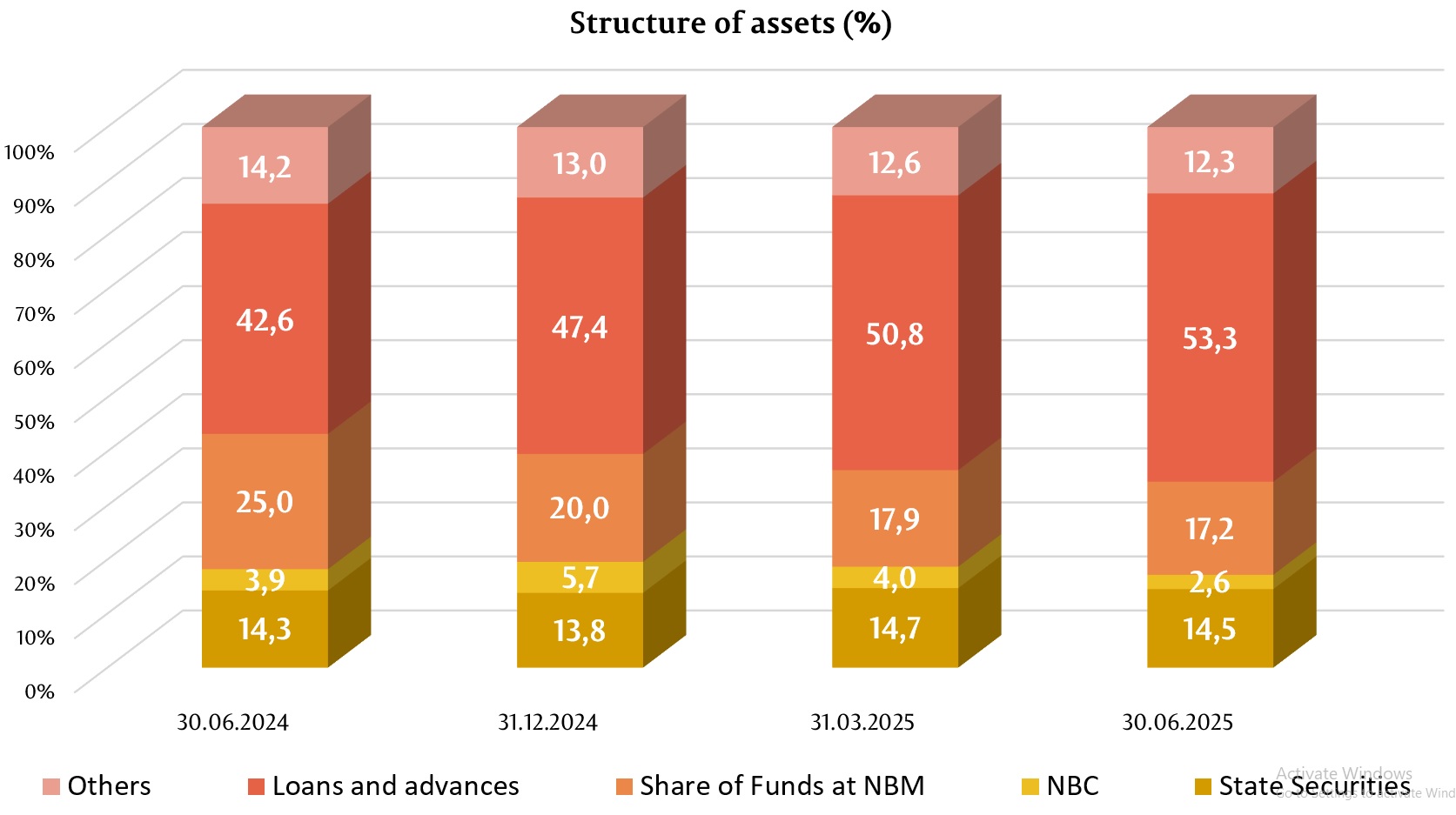
In the asset structure, the largest share was represented by the balance sheet item "Loans and advances at amortized cost," which amounted to 53.3% (MDL 93,760.3 million), up by 5.9 percentage points (p.p.) compared to the end of the previous year. The share of funds placed with the NBM stood at 17.2% (MDL 30,284.6 million), down by 2.7 p.p., while the share of banks' investments in state securities and NBM certificates was 17.2% (MDL 30,212.1 million), down by 2.4 p.p. The remaining assets, which account for 12.3% (MDL 21,563.6 million), are held in other banks in cash, tangible assets, intangible assets, etc. Their share decreased by 0.7 p.p. compared to the end of 2024.
 [1]
[1]
The gross (prudential) balance of loans accounted for 53.4% of total assets, or MDL 93,953.4 million, increasing by 16.2% (MDL 13,128.8 million) during the period under review.
The largest increase was recorded in loans granted for the purchase/construction of real estate - by MDL 3,960.8 million (21.3%), up to MDL 22,567.8 million, loans granted to trade – by MDL 2,298.5 million (13.7%) up to MDL 19,132.7 million, consumer loans – by MDL 2,230. 9 million (15.1%) to MDL 16,991.8 million, and other loans granted increased by MDL 1,479.5 million (65.9%) to MDL 3,724.5 million.
At the same time, during the first half of 2025, the decrease was recorded only in loans granted to administrative-territorial units/institutions subordinated to administrative-territorial units, by MDL 125.0 million (11.4%) to MDL 970.7 million.
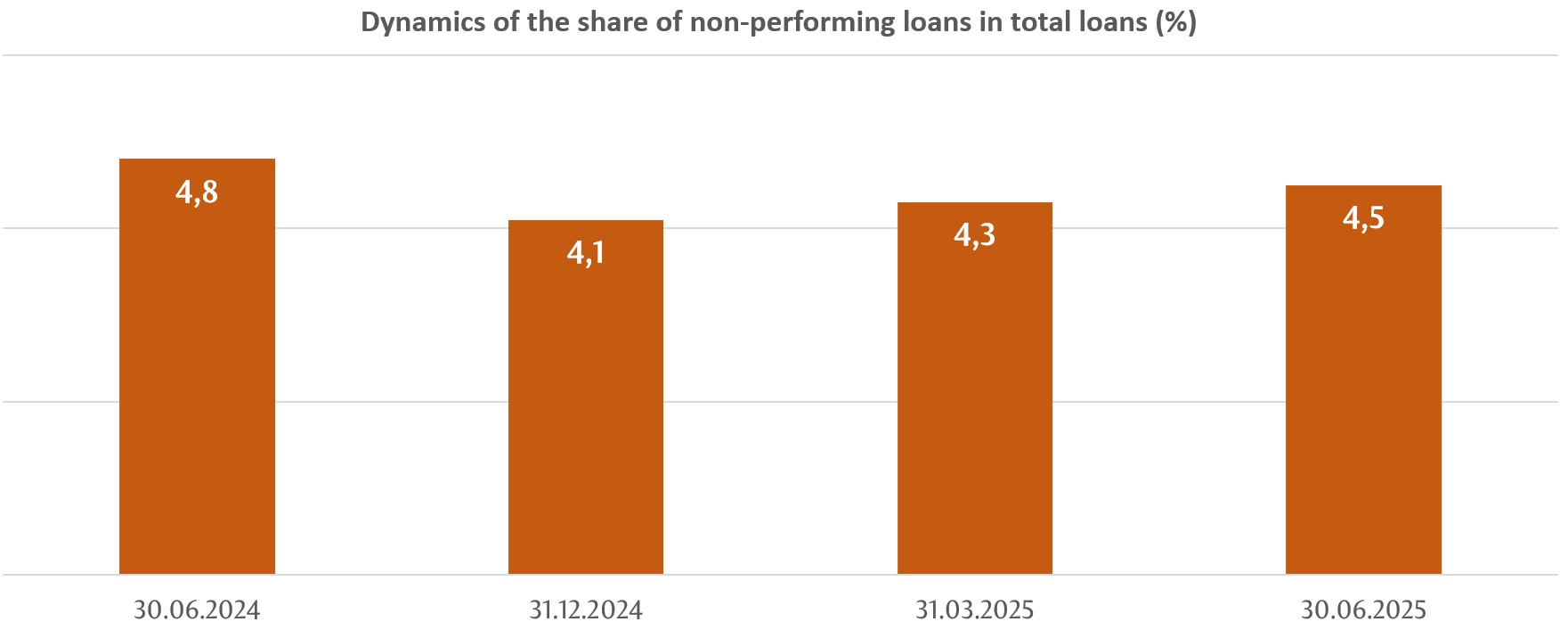
During the reference period, the share of non-performing loans in total loans stood at 4.5% as of 30 June 2025, recording a slight increase of 0.4 p.p. At the same time, during the period under review, expired loans decreased by 3.1% (MDL 48.1 million) to MDL 1,498.8 million. The share of expired loans in total loans was 1.6%, decreasing by 0.3 p.p. compared to 31 December 2024, ranging from 0.7% to 4.8%, depending on the bank.
 [2]
[2]
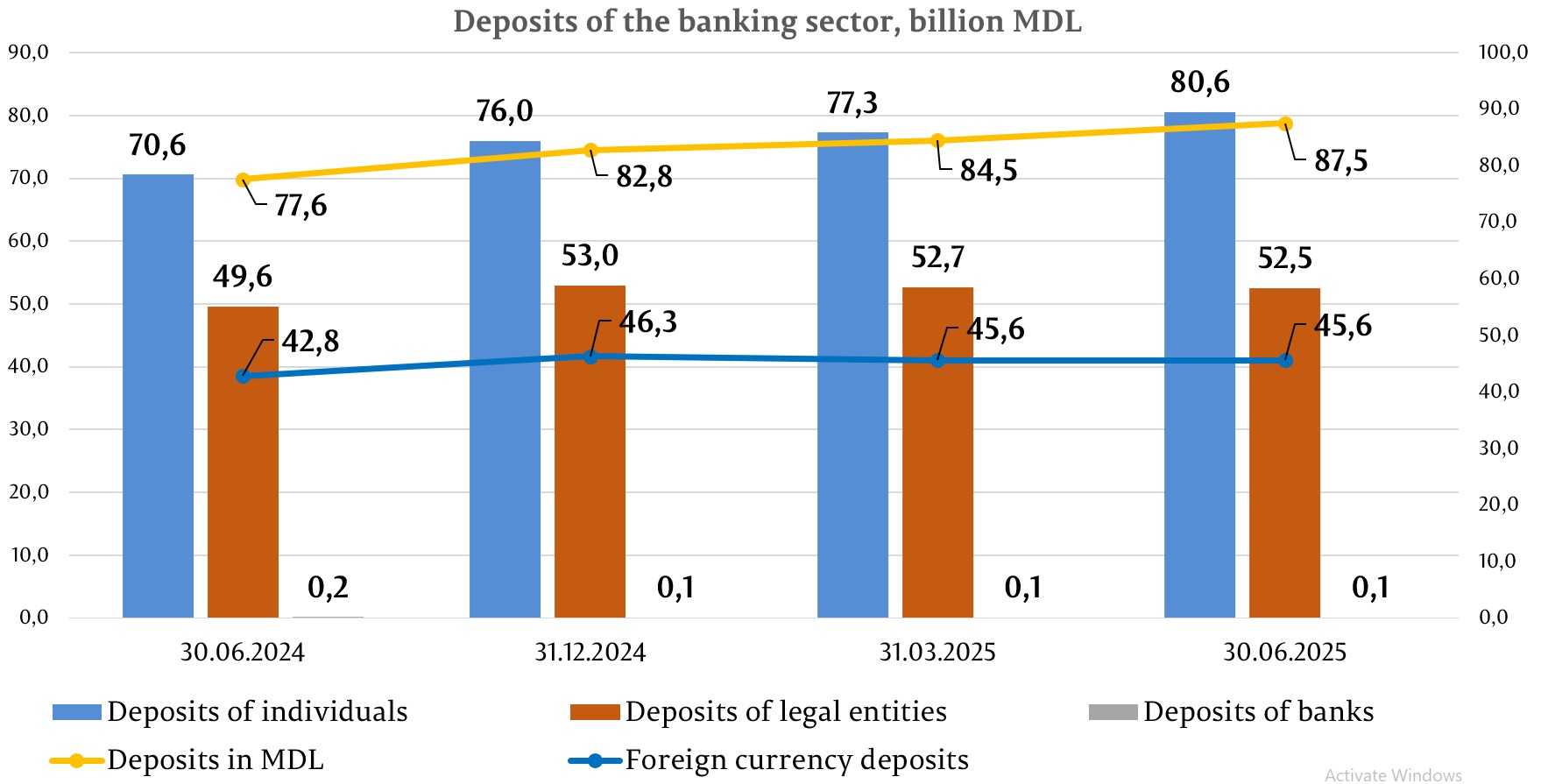
In the first half of 2025, the total balance of deposits increased by MDL 4,101.0 million or 3.2%, amounting to MDL 133,192.7 million (deposits of individuals accounted for 60.5% of total deposits, deposits of legal entities – 39.4%, and deposits of banks – 0.1%), as a result of an increase in the balance of deposits of individuals by MDL 4,609.0 million (6.1%) to MDL 80,567.4 million and a decrease in the balance of deposits of legal entities by MDL 482.6 million (0.9%) to MDL 52,529.4 million.
Of the total deposits, 65.7% were deposits in MDL, their balance increasing by MDL 4,775.0 million (5.8%) compared to the end of the previous year and amounting to MDL 87,542.8 million as of 30 June 2025. Foreign currency deposits accounted for 34.3% of total deposits, their balance decreasing during the reference period by MDL 674.0 million (1.5%), amounting to MDL 45,649.9 million.
 [3]
[3]
Revenues and profitability
As of 30 June 2025, the return on assets was 2.3%, and the return on equity was 14.3%, decreasing by 0.1 p.p. and 0.5 p.p., respectively, compared to the end of the previous year, in line with the expansion of activity and diversification of banking services and reflecting the overall attractiveness and stability of the banking sector.
Compliance with prudential requirements
During the first half of 2025, banks continued to maintain liquidity ratios at a high level, above the regulatory limits.
Thus, the value of the long-term liquidity ratio (liquidity principle I) was 0.79 (limit ≤1), increasing slightly by 0.03 compared to the end of 2024.
Liquidity Principle III, which represents the ratio between adjusted effective liquidity and required liquidity for each maturity band and which must not be less than 1 for each maturity band, was also complied with by all banks.
The liquidity coverage ratio by sector stood at 228.6% (limit ≥ 100%), continuing to record comfortable values for each bank in the sector.
According to reports submitted by banks as of 30 June 2025, the total capital adequacy ratio for the banking sector was 25.6%, with the minimum prudential requirement being 10%. All banks complied with the "Total own funds ratio" indicator (≥10%).
Banks also complied with the "Total own funds ratio" indicator requirement, taking into account capital buffers.
As of 30 June 2025, total own funds amounted to MDL 23,695.4 million, an increase of 5.5% (MDL 1,228.1 million). The growth in own funds was driven by the inclusion of eligible profits by some banks, after the general meetings of shareholders and after obtaining the permission from the NBM to include the profits obtained in own funds. At the same time, seven banks distributed dividends in accordance with the decisions of the shareholders.
As of 30 June 2024, banks complied with prudential indicators regarding large exposures and exposures to their related persons.
During the reporting period, banks broadly complied with the dominant position limit in the banking market, remaining below the 35% limit for this indicator in terms of assets and deposits of individuals, with one exception: assets amounted to 35.8% and deposits to 35.6%.
Development of the national legislative framework and its harmonisation with EU legislation
In the second quarter of 2025, the National Bank of Moldova continued its sustained efforts to modernise the secondary regulatory framework in order to implement Law No 202/2017 and align with Basel III requirements.
Thus, by Decision No 176/2025 of the Executive Board of the NBM, the new Regulation on leverage was approved, transposing the provisions of Part Seven of Regulation (EU) No 575/2013, as amended by Regulation (EU) No 2024/1623.
The Regulation on leverage aims to:
- define leverage, specify the entities to which the provisions of the Regulation apply—banks and branches in the Republic of Moldova of banks from other countries, as well as the basis for its calculation—individual basis and consolidated basis;
- establish the mechanism for calculating the leverage ratio (dividing the bank's capital measurement indicator by the bank's total exposure measurement indicator);
- describe the methodology for calculating the exposure measurement indicator (assets, derivative financial instruments, off-balance sheet items);
- establish the requirement for banks to report the leverage ratio indicator to the NBM.
At the same time, point 130 of Regulation No 109/2018 on own funds of banks and capital requirements was supplemented by establishing the leverage ratio at 3%.
Regulation No 158/2020 on banks' disclosure requirements has been adjusted so that, starting from 1 January 2026, banks will be required to disclose information on the leverage ratio indicator and its components.
Additionally, the provisions of Regulation No. 322/2018 on the framework for the administration of banking activities have been adjusted in accordance with the new Regulation on leverage.
At the same time, in the spirit of transparency in decision-making, the National Bank of Moldova published the draft Decision of the Executive Board "On the approval of the Regulation on the prudential treatment of securitizations."
The draft decision was developed in the context of the National Bank of Moldova's firm commitment to align the Republic of Moldova's banking legislation with the European Union acquis and aims to approve the secondary regulatory framework on the prudential treatment of securitizations.
At the same time, in the second quarter of 2025, the National Bank of Moldova continued the process of adjusting the legal framework of the Republic of Moldova in the field of foreign exchange, in accordance with the European Union legislation covering Chapter 4 - Free movement of capital.
In this context, and with a view to implementing the National Action Plan for the Republic of Moldova's accession to the European Union 2024–2027 (approved by Government Decision No 829/2023), the draft law prepared by the NBM to amend Law No 62/2008 on Foreign Exchange Regulation was adopted by Parliament through Law No 124/2025, which entered into force on 12 July 2025.
The new law provides for the partial liberalisation of certain foreign exchange capital transactions by eliminating the authorisation regime for all categories of residents conducting transactions with financial instruments, as well as for licensed and non-resident banks when carrying out transactions involving the introduction or removal of cash in the national currency from the Republic of Moldova.
Through these initiatives, the National Bank of Moldova contributes to the modernisation of the national financial system and to the advancement of the Republic of Moldova's integration into the European Union. Thus, the ongoing efforts to harmonise legislation strengthen the transparency, stability, and resilience of the banking sector, benefiting both the economy and citizens.