
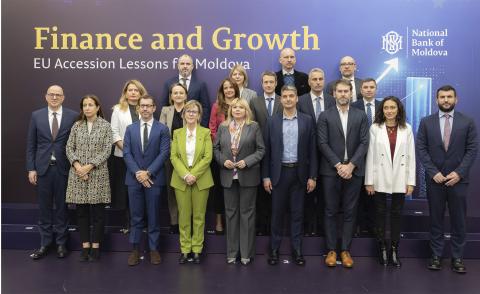
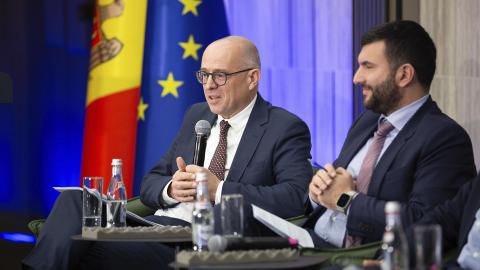

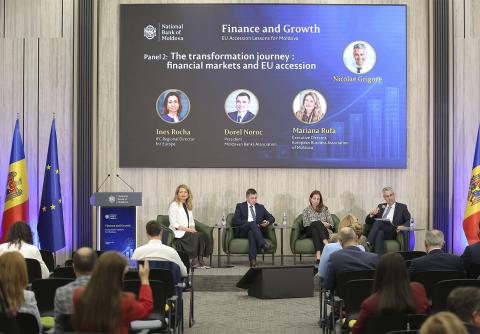


The National Bank of Moldova (NBM) organized today in Chisinau a high-level dialogue workshop titled "Finance and Economic Growth: Lessons for Moldova's European Path," an event that facilitated discussions on financial sector reforms and structural changes needed to increase economic growth in the process of European integration.
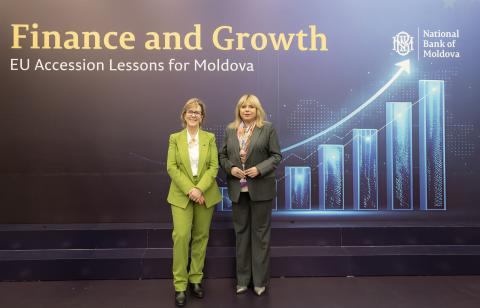
The workshop brought together senior officials from national and European authorities—Maria Luís Albuquerque, European Commissioner for Financial Services and the Savings and Investments Union, and Cristina Gherasimov, Deputy Prime Minister for European Integration of the Republic of Moldova—along with representatives of international financial institutions and renowned experts in the economic and financial sectors.
The event facilitated exploration of how financial reforms can effectively support SME development, innovation capacity, alignment of the legal framework with international standards, measures that can accelerate economic modernization, drawing on the accession experiences of Central and Eastern European countries.
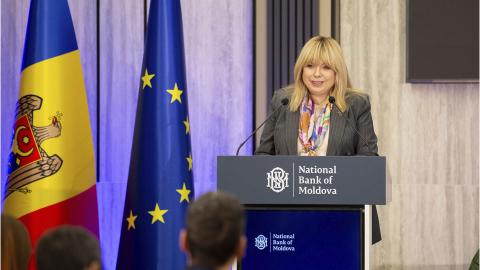
In her opening address, NBM Governor Anca Dragu emphasized that balanced and inclusive economic growth is only possible through a resilient, well-capitalized, and well-governed financial system, which no longer represents merely security, but becomes a true catalyst for long-term development, building trust and effectively mobilizing available resources.
"At the National Bank of Moldova, we believe that financial stability is a basic requirement for sustainable and inclusive growth. It is the foundation that encourages investment, stimulates innovation, and gives citizens confidence in their future. In recent years, Moldova has faced multiple challenges, including geopolitical ones, supply chain disruptions, and inflationary pressures. However, through prudent policies and a disciplined monetary policy stance, we have maintained stability and strengthened resilience," emphasized Ms. Anca Dragu.
In this context, the governor of the central bank noted that bringing inflation down reflects the effectiveness of monetary policies, and the successful accession of the Republic of Moldova to SEPA (Single Euro Payments Area) confirms the maturity of the financial system and connects it directly to the European infrastructure, which means faster, safer, and significantly cheaper transfers in euros.
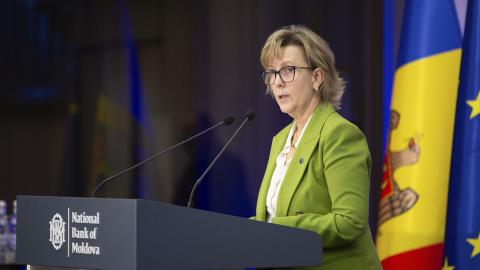
A highlight was the speech by Ms. Maria Luís Albuquerque, European Commissioner for Financial Services and the Savings and Investments Union, who gave an address in which she mentioned the European Union's commitment to supporting the Republic of Moldova in its integration process, underlining that the European market brings rapid and tangible benefits, which will be sustained by the reforms implemented.
“The European Union stands firmly behind you, and we value your determination. Every reform, every investment, every step toward a stronger, more integrated market strengthens not only Moldova's economy and democracy, but also its place and its voice in Europe — and Europe itself,” said Maria Luís Albuquerque.
Close cooperation between state institutions, the private sector and international partners will enable us to turn challenges into real development opportunities for the citizens of the Republic of Moldova, noted Deputy Prime Minister for European Integration Ms. Cristina Gherasimov, adding that "we will continue to work together with the NBM and society as a whole to build a stable, competitive, and transparent financial system that supports entrepreneurs, innovation, and strengthens people's confidence and the country's economic growth."
The event agenda included two other keynote sessions and panel discussions.
Luca Gattini, Head of Macro Scenario Unit at European Investment Bank, gave a keynote on financial markets and SME development, highlighting that Moldova's path to economic growth and convergence relies on ambitious reforms and a dynamic financial sector.
"Unlocking growth, jobs, investment, and innovation starts with better access to finance. The integration of banking and the development of capital market are the bedrock of lasting prosperity.
To break down credit barriers and empower businesses, Moldova needs continue support in the shape of targeted credit lines, risk-sharing tools, streamlined procedures, sharper risk assessments, stronger financial literacy, modernized collateral rules, and deeper capital markets,” said Luca Gattini.
Basile Grassi, Assistant Professor of Economics at Bocconi University in Milan, and associate researcher at OFCE, noted in his address that “the European Union’s expansion has been a development miracle, lifting more than 75 million people into lasting prosperity. Moldova can draw on these lessons to make its own European future a success story.”.
The event also included two high-level panel discussions focusing on the challenges and opportunities of Moldova's European path. The panel on "Productivity and Convergence," moderated by Svetlana Cerovic, IMF Resident Representative, brought together voices from the World Bank, EBRD, OECD, and National Bank of Moldova to analyze the factors driving economic convergence and the role of the financial sector in stimulating productivity.
The second panel, "The Transformation Path: Financial Markets and EU Accession," moderated by Nicolae Grigore, EU High Level Adviser on Financial Services, brought together representatives of the International Finance Corporation, the Moldovan Banks Association, and the European Business Association Moldova, who approached subjects related to the modernization of the financial sector in the context of European integration.
Among the central topics discussed were the alignment of the financial sector with European standards and the strengthening of the prudential supervisory framework, sustainable investments aimed at the green transition, the development of small and medium-sized enterprises by increasing competitiveness and stimulating innovation, as well as the digital transformation of the economy.
The high-level dialogue workshop "Finance and Economic Growth: Lessons for Moldova's European Path" is part of a series of strategic events organized by the National Bank of Moldova to facilitate the exchange of experience and best practices between national authorities, European institutions, and the international community of experts. The event reaffirms the National Bank's commitment to supporting dialogue and cooperation in support of the modernization and European integration of the Republic of Moldova.
(1st part) High-level dialogue workshop "Finance and economic growth: Lessons for Moldova's European path"
(2nd part) High-level dialogue workshop "Finance and economic growth: Lessons for Moldova's European path"
(3rd part) High-level dialogue workshop "Finance and economic growth: Lessons for Moldova's European path"