
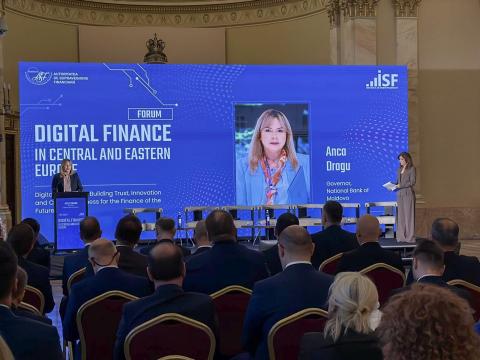
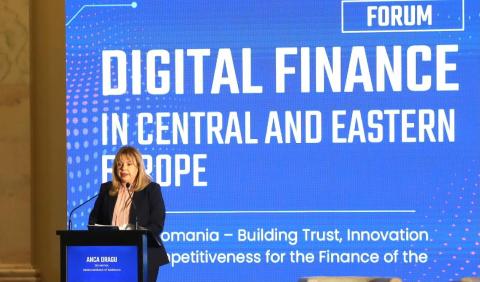
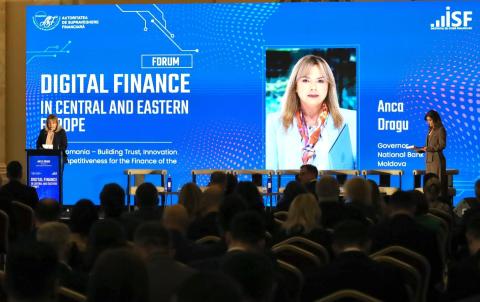
Today, 12 November 2026, the Governor of the National Bank of Moldova (NBM) Ms Anca Dragu delivered an opening address at the ‘Digital Finance in Central and Eastern Europe’ Forum, held in Bucharest. The Governor outlined the Republic of Moldova’s experience in modernising payments and discussed the role of the authorities in supporting innovation, managing technological risks and maintaining financial stability.
The forum brought together regulatory and supervisory authorities, European institutions, international organisations, and representatives from academia and the private sector to discuss how new technologies can improve financial services and boost the competitiveness of markets in the region.
“Making the most of the opportunities offered by new technologies, managing the risks they entail and maintaining financial stability are priorities for regulatory and supervisory authorities. In the Republic of Moldova, the modernisation of payments is already changing the way businesses operate. An entrepreneur can receive payments from customers in a matter of seconds via MIA Instant Payments and can pay a supplier’s invoice from any European country via SEPA, at a lower fee. Through clear rules and supervision proportionate to the risks, we are creating the conditions for these services to develop, so that people and businesses can use them with confidence,” emphasised the Governor of the NBM.
Domestically, the MIA Instant Payments system, developed by the NBM, has reached nearly 1.1 million users and processed over 38.8 million transactions since its launch. For cross-border payments, connection to the Single Euro Payments Area (SEPA) has reduced the costs of transfers in euros. In the first year following the operational connection, citizens and businesses in the Republic of Moldova carried out around 1.2 million transfers via SEPA. According to NBM estimates, for these transfers, citizens and businesses paid approximately EUR 16.4 million less in fees than they would have paid via the traditional SWIFT system.
Connecting to the European payments infrastructure forms part of a wider process of alignment with EU rules, as also reflected in the European Commission’s 2026 Report on the Republic of Moldova. The document shows that national legislation in the field of payments is largely aligned with the European Payment Services Directive (PSD2). It also notes that the banking sector remains stable and well-capitalised, with solid liquidity reserves.
“For an investor undertaking a long-term project, it is important to know the rules under which they will operate and the financial services on which they can rely. The Republic of Moldova has a solid banking sector, increasingly digitalised financial services and a regulatory framework that we are bringing into line with European standards. The National Bank will continue, through its mandate, to contribute to maintaining financial stability and modernising the infrastructure that businesses need to attract capital and invest in the long term,” added the Governor of the National Bank of Moldova.
The forum was organised by the Romanian Financial Supervisory Authority, in collaboration with the Institute of Financial Studies.