Welcome to the official website of the National Bank of Moldova!
×
Do you have good eyesight and want to turn this tool off?



Welcome to the official website of the National Bank of Moldova!
You can choose one of the most popular reports from the list:

National Bank and the members of its decision-making bodies shall be independent in exercising the tasks conferred upon them by law, and shall neither seek nor take instructions from public authorities or from any other authority.

In order to ensure and maintain price stability over the medium term, the National Bank’s aim will be to keep inflation (measured by Consumer Price Index) at the level of 5.0 percent annually with a possible deviation of ± 1.5 percentage points, considered to be optimal for growth and development of Moldova's economy over the medium-term.

Financial stability is achieved by strengthening the resilience of the financial system, limiting the contagion effect and reducing the accumulation of systemic risks, thus contributing to the sustainability of the financial sector and economic growth.
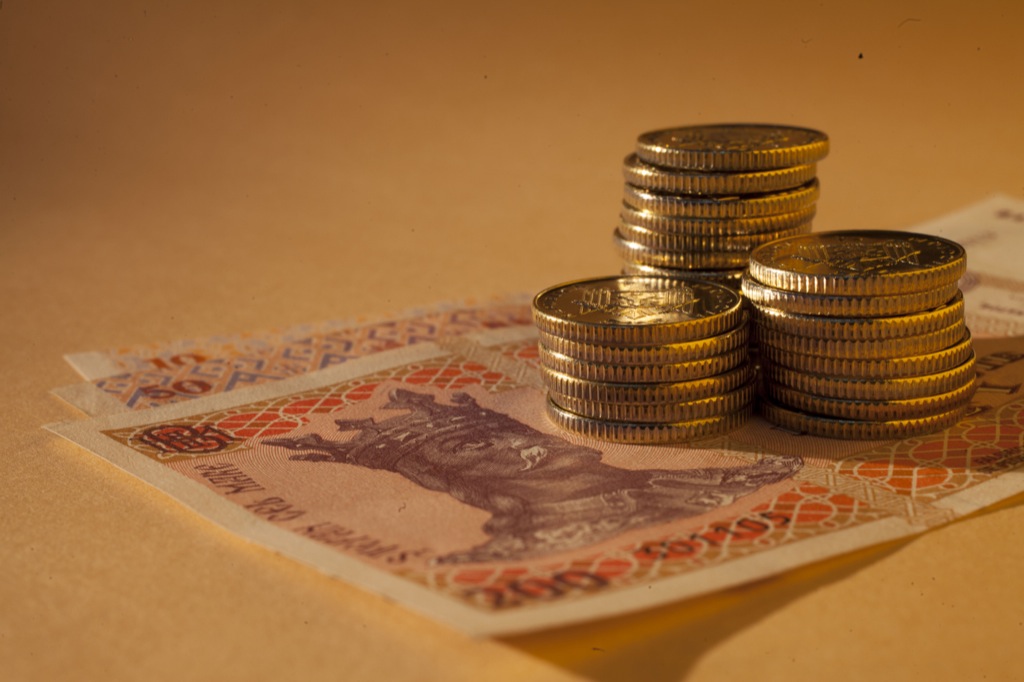
National Bank shall have the exclusive right to issue on the territory of the Republic of Moldova banknotes and coins as legal tender, as well as commemorative and jubilee banknotes and coins as legal tender and for numismatic purposes.

National Bank is exclusively responsible for the licencing, supervision and regulation of financial institutions activity.

National Bank of Moldova acts as banker and fiscal agent of the State and shall receive from state bodies economic and financial information and documents, which are necessary for carrying out its tasks.
National Bank of Moldova is an autonomous public legal entity and is responsible to the Parliament.

National Bank shall inform the public on the monetary policy strategy on the results of the macroeconomic analysis, the evolution of the financial market and on statistics, including with regard to monetary supply, crediting, balance of payments and the state of the foreign exchange market.

National Bank of Moldova is responsable for the compilation of the balance of payments, international investment position and the statistics of the external debt of the Republic of Moldova.
The National Bank of Moldova (NBM) announces that, as of 2 January 2025, the euro will be used as the reference currency for setting the official exchange rate of the Moldovan leu, replacing the US dollar. The decision reflects the Republic of Moldova's economic shift towards the European Union market, which plays a significant role in the country's trade and financial structure.
This change will reduce fluctuations in the exchange rate of the Moldovan Leu against the euro and the differences between the buying and selling rates of the euro, benefiting the economy and helping to reduce foreign exchange costs.
This shift is aimed at aligning with economic realities, as the European Union is Moldova's most important trading partner and the main source of remittances and foreign direct investment. Official data show that more than 60% of trade transactions and 70% of remittances are in euros, which is the most popular currency on the local foreign exchange market. The change will contribute to the stability of the exchange rate, benefiting the economy.
Similarly, the use of the euro as the reference currency is a methodological decision aimed at aligning Moldova's financial structures with those of the European Union, without affecting the monetary policy of the NBM. Citizens and economic agents will not feel a direct impact, as the transition is a technical one, intended to support macroeconomic stability and alignment with European standards.
Citizens will benefit from the stability of the EUR/MDL exchange rate, reduced currency risk and lower transaction costs – key factors for those receiving remittances or holding loans in euro.
For the business environment, reducing exchange rate volatility will support financial planning and reduce risks in trade transactions with EU partners. The banking sector and economic agents will also benefit from a more liquid EUR/MDL foreign exchange market and lower transaction costs.
The NBM will publish detailed information on its official website and other communication platforms, provide a set of answers to frequently asked questions and organize public consultation sessions to ensure transparency and clarity of the process.
Further information can be found HERE.


