Welcome to the official website of the National Bank of Moldova!
×
Do you have good eyesight and want to turn this tool off?



Welcome to the official website of the National Bank of Moldova!
You can choose one of the most popular reports from the list:

National Bank and the members of its decision-making bodies shall be independent in exercising the tasks conferred upon them by law, and shall neither seek nor take instructions from public authorities or from any other authority.

In order to ensure and maintain price stability over the medium term, the National Bank’s aim will be to keep inflation (measured by Consumer Price Index) at the level of 5.0 percent annually with a possible deviation of ± 1.5 percentage points, considered to be optimal for growth and development of Moldova's economy over the medium-term.

Financial stability is achieved by strengthening the resilience of the financial system, limiting the contagion effect and reducing the accumulation of systemic risks, thus contributing to the sustainability of the financial sector and economic growth.
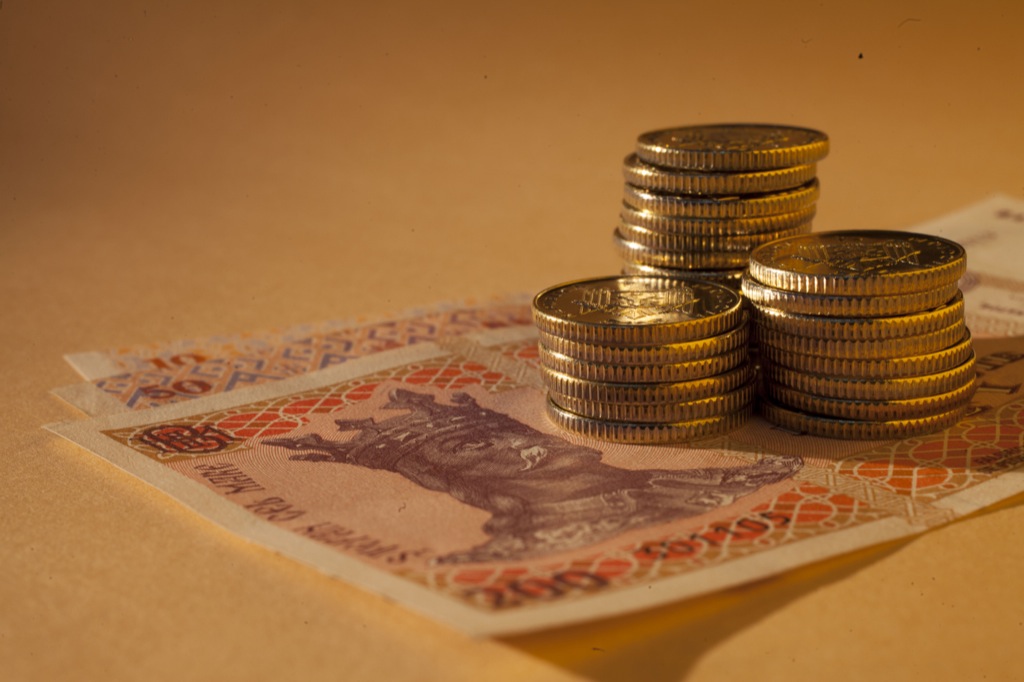
National Bank shall have the exclusive right to issue on the territory of the Republic of Moldova banknotes and coins as legal tender, as well as commemorative and jubilee banknotes and coins as legal tender and for numismatic purposes.

National Bank is exclusively responsible for the licencing, supervision and regulation of financial institutions activity.
National Bank of Moldova acts as banker and fiscal agent of the State and shall receive from state bodies economic and financial information and documents, which are necessary for carrying out its tasks.
National Bank of Moldova is an autonomous public legal entity and is responsible to the Parliament.

National Bank shall inform the public on the monetary policy strategy on the results of the macroeconomic analysis, the evolution of the financial market and on statistics, including with regard to monetary supply, crediting, balance of payments and the state of the foreign exchange market.

National Bank of Moldova is responsable for the compilation of the balance of payments, international investment position and the statistics of the external debt of the Republic of Moldova.


The Governor of the National Bank of Moldova, Anca Dragu, met with professors from educational institutions with an economic focus to discuss the Republic of Moldova's accession to the Single Euro Payments Area (SEPA), the system dedicated to cross-border euro bank transfers and the advantages of accession for citizens and the economy.
"Today, we are discussing a payment system that will change the country's economic future," stated Anca Dragu. " The integration of the Republic of Moldova into a unified euro payments system will bring significant economic benefits at all levels, facilitating financial transactions between Moldova and other European countries. Joining SEPA will facilitate the reduction of costs for cross-border payments, will enhance access to modern financial instruments and will be an important boost for the development of the national economy", noted the NBM Governor.
Anca Dragu also emphasized the role of educators in shaping a clear and in-depth vision among students on the implications of our country's accession to SEPA and the importance of the daily commitment teachers make in passing on economic knowledge to future specialists.
The event had an interactive format, with substantive discussions and exchanges of ideas on the opportunities brought by the Republic of Moldova's accession to SEPA, the actions undertaken and the next steps. In this context, the discussions highlighted the responsibility of educators in the field of economics to provide students with a more comprehensive understanding of international economic and financial processes.
Representatives of the Academy of Economic Studies of Moldova and the State University of Moldova had the opportunity to address messages and questions to the participants, mentioning the importance of an educational curriculum adapted to international economic realities and the current needs of financial markets.
Thus, the Vice-Rector of the Academy of Economic Studies of Moldova, Victoria Cociug, stated: "It is time to rethink the role of schools and universities in shaping responsible citizens. The curriculum must be adapted to the new economic realities: digitalization, financial innovation, sustainability. Financial education should be introduced not just as an optional subject, but as an integral part of the education of young people and adults. We propose an integrated approach - in partnership with the NBM, financial institutions, the public sector and the academic environment - to develop real, useful and applicable skills."
Additionally, the Dean of the Faculty of Economic Sciences of the State University of Moldova, Maria Hămuraru, pointed out: "The modernization of the curriculum by integrating current topics, such as modern payment systems infrastructure, digital banking and SEPA regulations, reflects our commitment to providing students with relevant training adapted to the requirements of the labour market. Through these initiatives, we aim not only to improve the quality of professional training, but also to strengthen financial literacy among young people - a crucial factor for the sustainable development of the national economy."
In conclusion, the Governor of the National Bank, Anca Dragu, emphasized the importance of collaboration between financial authorities and economic educational institutions in preparing new generations of professionals who will contribute to strengthening a more efficient economic system, better connected to the global market.


