Welcome to the official website of the National Bank of Moldova!
×
Do you have good eyesight and want to turn this tool off?



Welcome to the official website of the National Bank of Moldova!
You can choose one of the most popular reports from the list:

National Bank and the members of its decision-making bodies shall be independent in exercising the tasks conferred upon them by law, and shall neither seek nor take instructions from public authorities or from any other authority.
In order to ensure and maintain price stability over the medium term, the National Bank’s aim will be to keep inflation (measured by Consumer Price Index) at the level of 5.0 percent annually with a possible deviation of ± 1.5 percentage points, considered to be optimal for growth and development of Moldova's economy over the medium-term.

Financial stability is achieved by strengthening the resilience of the financial system, limiting the contagion effect and reducing the accumulation of systemic risks, thus contributing to the sustainability of the financial sector and economic growth.
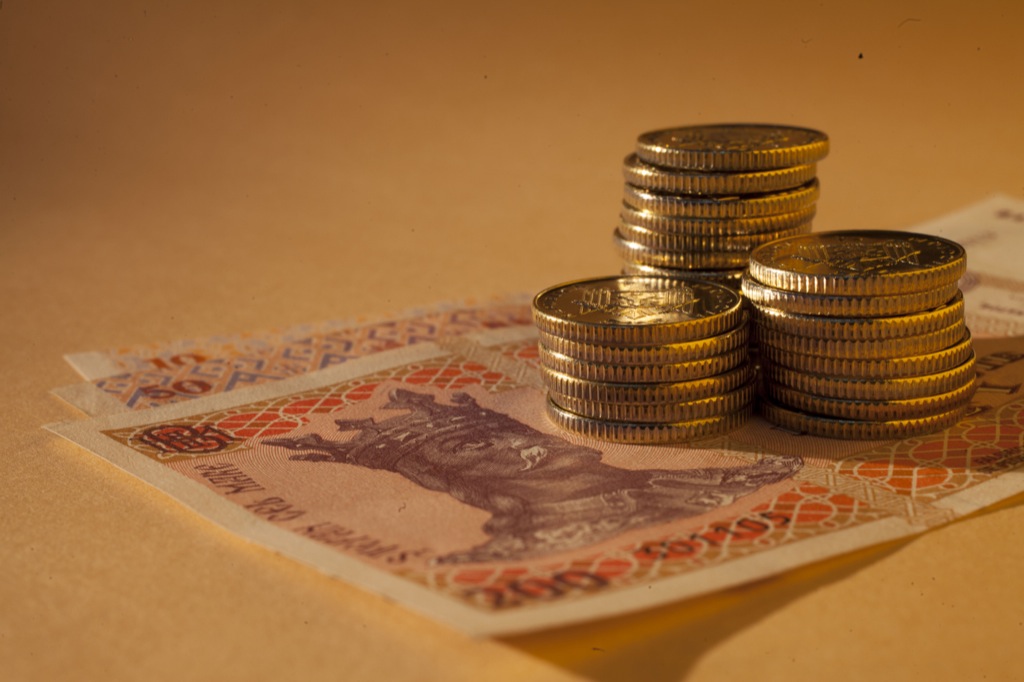
National Bank shall have the exclusive right to issue on the territory of the Republic of Moldova banknotes and coins as legal tender, as well as commemorative and jubilee banknotes and coins as legal tender and for numismatic purposes.

National Bank is exclusively responsible for the licencing, supervision and regulation of financial institutions activity.
National Bank of Moldova acts as banker and fiscal agent of the State and shall receive from state bodies economic and financial information and documents, which are necessary for carrying out its tasks.

National Bank of Moldova is an autonomous public legal entity and is responsible to the Parliament.

National Bank shall inform the public on the monetary policy strategy on the results of the macroeconomic analysis, the evolution of the financial market and on statistics, including with regard to monetary supply, crediting, balance of payments and the state of the foreign exchange market.

National Bank of Moldova is responsable for the compilation of the balance of payments, international investment position and the statistics of the external debt of the Republic of Moldova.
The Executive Board of the National Bank of Moldova, at its meeting on 7 May 2026, adopted by unanimous vote the following decision:
The National Bank adopted this decision in response to the need to shape monetary policy to mitigate pressures on inflation amid the intensifying effects of the conflict in the Middle East, reflected in rising international prices for energy resources, food, and raw materials, and their impact on the regional economic forecast, as well as the monetary and fiscal policies promoted by major economies.
Under these circumstances, the current short- and medium-term inflation forecast reinforces the certainty that the annual inflation rate in the coming months of 2026 will exceed the upper limit of the ±1.5 percentage point inflation target range of 5.0% per annum.
The upward trend in inflation over the course of this year, against the backdrop of an inflationary balance of risks in the current forecast round, highlights the need to implement monetary policy measures that diverge from the restrictive stance in order to ensure monetary conditions in line with the National Bank’s fundamental medium-term objective.
Thus, the NBM’s decision to increase the base rate is aimed at countering inflationary pressures, mitigating the second-round effects of supply shocks, and anchoring inflation expectations in order to bring the annual consumer price index back within the inflation target range.
The NBM will continue to closely monitor domestic and external macroeconomic conditions, as well as the risks and uncertainties associated with inflation trends in the short- and medium-term, and remains prepared to use the tools at its disposal, as necessary, to achieve its primary objective of ensuring and maintaining price stability.
The annual inflation rate stood at 5.81% in March 2026, rising by 0.75 percentage points compared to the previous month and maintaining for the third consecutive month a level within the ±1.5 percentage point range of the medium-term inflation target of 5.0%.
For the entire first quarter of 2026, the annual inflation rate stood at 5.24% and was insignificantly above the level anticipated in the forecast of the February 2026 Inflation Report, due to rising energy prices amid geopolitical tensions.
The external environment in the first quarter of 2026 was marked by an escalation of geopolitical and macroeconomic risks. Brent crude oil prices and European natural gas prices rose following the outbreak of war in the Middle East in late February 2026 and the closure of the Strait of Hormuz. In March, the U.S. dollar appreciated, while the euro recorded its sharpest depreciation since July 2025. Under these conditions, inflationary pressures intensified and market expectations shifted, which may lead to a change in the nature of the monetary policy measures implemented by some central banks, anticipating an increase in monetary policy interest rates throughout 2026.
The euro area economy grew by 0.8% in the first quarter of 2026, continuing to be affected by weak external demand, high energy prices, and geopolitical uncertainty. In this context, the economic growth forecast for the euro area has been revised downward, and the forecast for average annual inflation is above the ECB’s target. The war in the Middle East is affecting international food prices by reducing product supply and lowering export demand. Prices for cereal products at the beginning of May show an upturn due to rising fertiliser prices, geopolitical risk, and concerns about a decline in supply driven by unfavourable weather conditions. Consequently, international food prices are expected to rise in 2026–2027.
Economic activity. Data released by the National Bureau of Statistics (NBS) for the first two months of the quarter point to a favourable prospect for economic growth in the first quarter of 2026. Thus, in January–February 2026, industrial production increased by 2.8%, domestic retail trade grew by an average of 16.3%, and wholesale trade decreased by 0.4%. At the same time, the annual export rate stood at 11.6%, while the annual import rate fell by 0.6%. Total agricultural production was up 8.6% in the first quarter of 2026 compared to the same quarter of the previous year.
In terms of sources of consumer financing, in the first quarter of 2026, remittances from abroad to individuals increased by 10.4% compared with the same period of the previous year.
Monetary conditions. The weighted average interest rate on new loans granted in the domestic currency showed a downward trend in the first quarter of 2026, while the weighted average interest rate on new deposits in MDL continued its upward trend under the influence of previous monetary policy measures. Thus, the weighted average interest rate on loans stood at 9.06%, down by 0.06 percentage points, while that on deposits was 5.11%, up by 0.03 percentage points compared to the fourth quarter of 2025. During the first quarter of 2026, the volume of loans in MDL grew, while the volume of deposits decreased compared to the first quarter of 2025.
It should be noted that excess liquidity totalled MDL 5.2 billion in the first quarter of 2026, an increase of MDL 0.7 billion compared to the fourth quarter of 2025.
Forecast. Throughout the current year, the annual inflation rate will trend upward, and starting in the first quarter of 2027, it will decline through the end of the forecast horizon. Notably, in the second quarter of 2026, the annual inflation rate will reach the upper limit of the range, and subsequently, for three consecutive quarters, it will exceed it and, starting in the second quarter of 2027, will return within the range, where it will be maintained until the end of the forecast period. The average annual inflation rate for 2026 and 2027 will be 7.0% and 5.8%, respectively, an upgrade of 2.0 and 1.3 percentage points compared to the previous forecast. The upward revision of the annual inflation forecast compared to that in the February 2026 Inflation Report is driven by the expectation of a larger rise in international oil prices, higher international food prices throughout the comparable period, a higher trajectory for imported inflation in 2026, the projection of rising short-term inflation driven by second-round effects from rising fuel prices in the context of the war in the Middle East, and higher-than-anticipated actual inflation in the first quarter of 2026.
Risks and uncertainties. Amid expectations that the war in the Middle East will continue and that its adverse effects on international markets will intensify, the balance of risks associated with the current round of medium-term inflation forecasts is tilted toward higher inflation.
Thus, the main risks and uncertainties regarding medium-term inflation developments stem from the external environment, such as: the conflict in the Middle East with repercussions on oil and natural gas prices, the war in Ukraine, rising international prices for food and raw materials, the slowdown in the euro area economy, and rising external inflation. At the same time, major uncertainties and risks to inflation are associated with the timing and magnitude of the adjustment of tariffs on regulated services, uncertainty regarding this year’s agricultural production, and the vulnerability of domestic fruit and vegetable prices to weather conditions, as well as external financing and fiscal stimulus.
The Inflation Report for May 2026, which includes an analysis of the domestic and external economic situation as well as the medium-term inflation forecast, will be published on 14 May 2026.
The next meeting of the NBM Executive Board on monetary policy will be held on 18 June 2026, according to the approved schedule.


