Welcome to the official website of the National Bank of Moldova!
×
Do you have good eyesight and want to turn this tool off?



Welcome to the official website of the National Bank of Moldova!
You can choose one of the most popular reports from the list:

National Bank and the members of its decision-making bodies shall be independent in exercising the tasks conferred upon them by law, and shall neither seek nor take instructions from public authorities or from any other authority.
In order to ensure and maintain price stability over the medium term, the National Bank’s aim will be to keep inflation (measured by Consumer Price Index) at the level of 5.0 percent annually with a possible deviation of ± 1.5 percentage points, considered to be optimal for growth and development of Moldova's economy over the medium-term.

Financial stability is achieved by strengthening the resilience of the financial system, limiting the contagion effect and reducing the accumulation of systemic risks, thus contributing to the sustainability of the financial sector and economic growth.
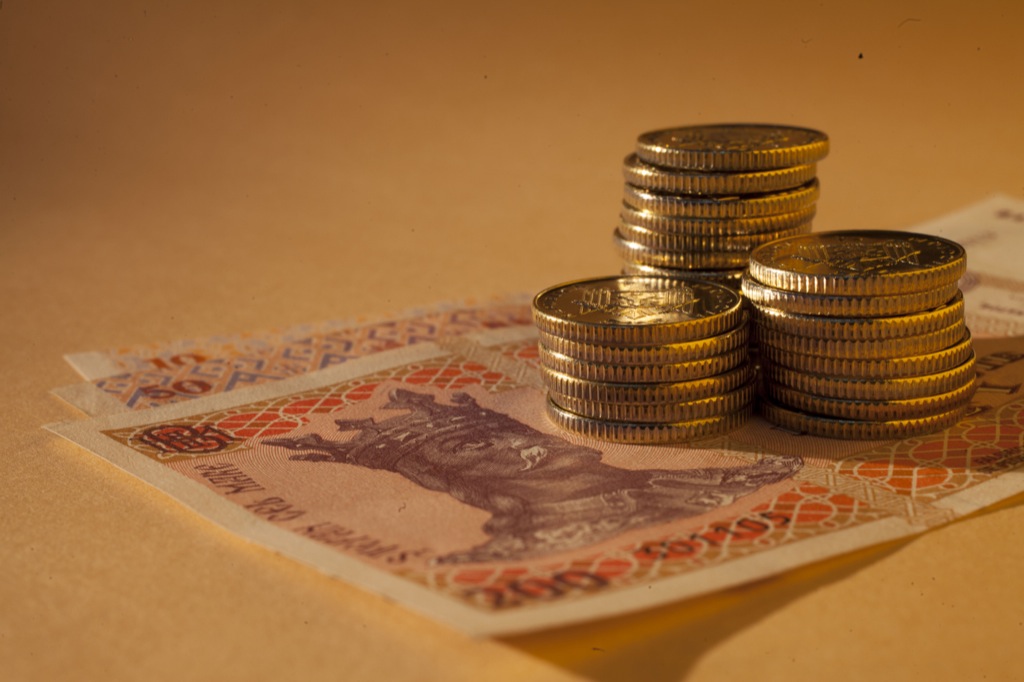
National Bank shall have the exclusive right to issue on the territory of the Republic of Moldova banknotes and coins as legal tender, as well as commemorative and jubilee banknotes and coins as legal tender and for numismatic purposes.

National Bank is exclusively responsible for the licencing, supervision and regulation of financial institutions activity.
National Bank of Moldova acts as banker and fiscal agent of the State and shall receive from state bodies economic and financial information and documents, which are necessary for carrying out its tasks.
National Bank of Moldova is an autonomous public legal entity and is responsible to the Parliament.

National Bank shall inform the public on the monetary policy strategy on the results of the macroeconomic analysis, the evolution of the financial market and on statistics, including with regard to monetary supply, crediting, balance of payments and the state of the foreign exchange market.

National Bank of Moldova is responsable for the compilation of the balance of payments, international investment position and the statistics of the external debt of the Republic of Moldova.
In November 2017, the annual inflation rate dropped to 7.3%, having decreased by 0.6 pp. compared to the previous month. The decline was recorded even despite the rise in fees for utility services, being determined by such factors as the nature of the supply and the effect of a low basic period recorded last year. Aggregate demand had a negligible effect on prices, which recorded a slight downward trend against the background of the domestic currency appreciation combined with other factors mentioned above.
The biggest contribution to the annual inflation rate (3.8 pp.) was brought by food prices, being 0.4 pp. lower than in the previous month. The core inflation’s contribution (1.5 pp.) to the annual inflation rate trajectory was similar to the previous month. The impact of fuel prices increased to 0.5 pp. while the contribution of regulated services decreased by 0.3 pp compared the previous month and recorded 1.4 pp.
The monthly inflation rate amounted to 0.7%, being driven by the rise in prices for foodstuffs, non-food products, and services.
The annual rate of core inflation recorded 5.0% in the reference month, having increased by 0.1 pp compared to the previous month.
At the same time, the monthly core inflation rate in November recorded 0.5%. The most significant price increases were recorded for subcomponents: "cigarettes", "daily household maintenance", "footwear", and "clothing".
The increase in food prices by 1.1%, compared to October 2017, was mainly determined by the rise in prices for "eggs" (17.2%), "fresh vegetables" (6.0%), "potatoes" (3.4%), "milk and dairy products" (0.9%), "fats" (0.7%), and "meat, meat products, and canned meat" (0.5%). Excluding the seasonal factor, food prices remained at the level of the previous month. The rise in prices for meat, meat products, and canned meat has resulted from the shortage in meat supply recorded as a result of the ban imposed on meat imports from Ukraine.
The annual growth rate of food prices fell to 9.6%, being 1.0 pp. lower than in October 2017 and 6.4 pp higher than in November 2016.
In November 2017, oil prices rose 1.8% over the level of the previous month. This development was mainly influenced by the rise in 'fuel' prices by 1.9%, generating a contribution of 1.1 pp. The fuel price dynamics was driven by higher gasoline and diesel prices in line with the oil price trend recorded on the international market. Prices for "firewood" increased by 2.3%, for "coal" - by 0.5%, while prices for "bottled gas" decreased by 0.1%. At the same time, prices for "liquid fuel" remained at the level of October 2017.
In November 2017, the annual growth rate of fuel prices amounted to 7.4%, having increased by 1.2 pp. compared to the previous month and 8.5 pp. compared to November 2016.
In the reference month, prices for regulated services and products declined by 0.1% compared to October, being driven by the 0.8% decrease in drug prices. Airline tariffs increased by 1.5% while prices on international rail services decreased by 2.7%.
The annual growth rate of regulated products and services recorded 6.2%, being 1.0 pp. lower compared to the previous month and 7.4 pp. higher than in November 2016.
The NBM will monitor the developments on domestic and international economic markets, and will use the operational framework specific to the inflation targeting strategy in order to maintain the medium-term price stability.


