Welcome to the official website of the National Bank of Moldova!
×
Do you have good eyesight and want to turn this tool off?



Welcome to the official website of the National Bank of Moldova!
You can choose one of the most popular reports from the list:

National Bank and the members of its decision-making bodies shall be independent in exercising the tasks conferred upon them by law, and shall neither seek nor take instructions from public authorities or from any other authority.
In order to ensure and maintain price stability over the medium term, the National Bank’s aim will be to keep inflation (measured by Consumer Price Index) at the level of 5.0 percent annually with a possible deviation of ± 1.5 percentage points, considered to be optimal for growth and development of Moldova's economy over the medium-term.

Financial stability is achieved by strengthening the resilience of the financial system, limiting the contagion effect and reducing the accumulation of systemic risks, thus contributing to the sustainability of the financial sector and economic growth.
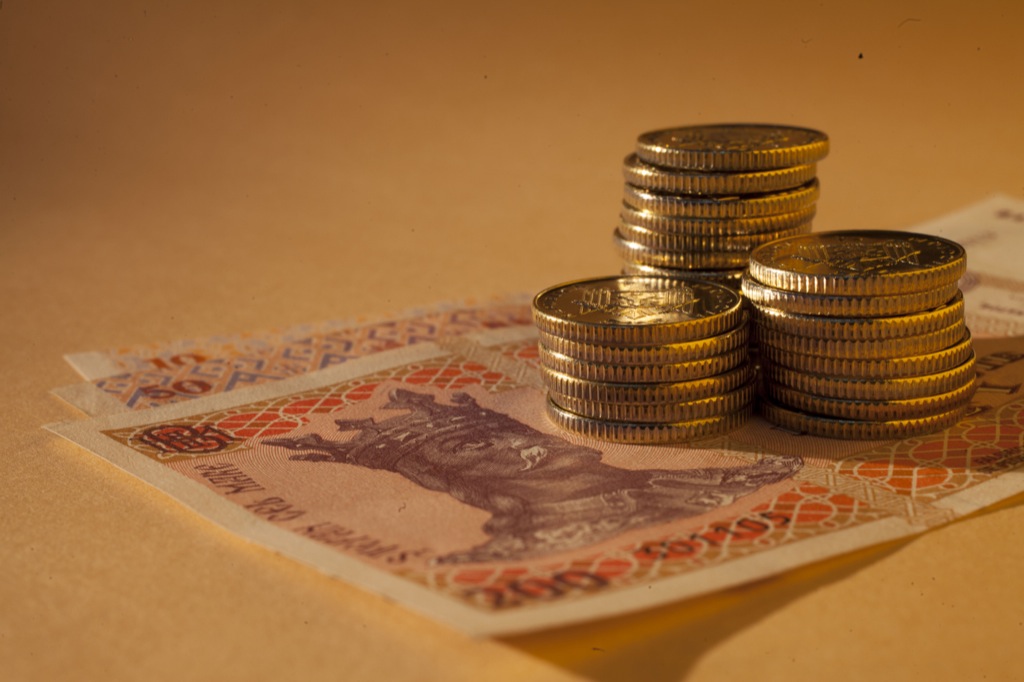
National Bank shall have the exclusive right to issue on the territory of the Republic of Moldova banknotes and coins as legal tender, as well as commemorative and jubilee banknotes and coins as legal tender and for numismatic purposes.

National Bank is exclusively responsible for the licencing, supervision and regulation of financial institutions activity.
National Bank of Moldova acts as banker and fiscal agent of the State and shall receive from state bodies economic and financial information and documents, which are necessary for carrying out its tasks.

National Bank of Moldova is an autonomous public legal entity and is responsible to the Parliament.

National Bank shall inform the public on the monetary policy strategy on the results of the macroeconomic analysis, the evolution of the financial market and on statistics, including with regard to monetary supply, crediting, balance of payments and the state of the foreign exchange market.

National Bank of Moldova is responsable for the compilation of the balance of payments, international investment position and the statistics of the external debt of the Republic of Moldova.
Inflation Report, November 2025
In the third quarter of 2025, the annual inflation rate continued the downward trend of previous periods, decreasing from 8.2% in June 2025 to 6.9% in September 2025. At the same time, the average annual inflation rate was 7.4%, about 0.5 percentage points lower than in the previous quarter. However, the annual inflation rate, starting from December 2024 and in the first nine months of the current year, was above the upper limit of the inflation target variation range, a fact determined by the dynamics of regulated prices, in the context of the tariff adjustment for mains gas, thermal energy and electricity. Yet, the annual inflation rate without that impact was about 4.4% in September 2025, being within the range of variation of the inflation target. At the same time, in the third quarter of 2025, the annual inflation rate was similar to the value anticipated in the Inflation Report, August 2025. The annual price increase in the first nine months of this year was mainly generated by some supply shocks, including the adjustment of the tariff for mains gas, thermal energy and electricity, as well as by the unfavorable agrometeorological conditions in the spring that exerted pressure on food prices. According to estimates, the aggregate demand continued to exert a disinflationary impact on prices during the reference period. The adjustment of energy resource tariffs at the end of the previous year and the beginning of the current year placed the annual inflation rate above the upper limit of the inflation target variation range in the coming period. The manner of adjusting tariffs, as well as the tense situation in the region and the risks of its escalation, maintains the pronounced uncertainty related to the inflation forecast.
Despite considerable shocks, economic and geopolitical tensions, the global economy proved resilient in the third quarter of 2025. At the same time, pronounced uncertainties, trade fragmentation and the reshaping of global supply chains are expected to have a negative effect on the growth rate of the world economy. IMF forecasts indicate a slowdown in global growth from 3.3% in 2024 to 3.2% in 2025 and 3.1% in 2026. The decline in consumer and business confidence is reflected in data on moderate growth in consumption and investment in major economies. The slowdown in the global economy, in the context of high public debts, increases concerns about the sustainability of public finances and possible cross-border effects. The decline of consumer and business confidence is reflected in data on moderate growth in consumption and investment in major economies. The slowdown in the global economy, in the context of high public debts, increases concerns about the sustainability of public finances and possible cross-border effects. In this context, the trend of easing the monetary policies of the main central banks continues. Negotiations to end the war in Ukraine have not produced any results. On the contrary, the armed conflict has intensified in recent months. The ceasefire agreement in the Gaza Strip paves the way for a peace agreement in the region and for a possible extension of the Abraham Accords on the normalization of diplomatic relations between the states of the Middle East.
In the second quarter of 2025, the annual GDP dynamics returned to positive territory, after the negative values in the second half of the previous year and the beginning of this year. In the period from April to June 2025, GDP increased by 1.1%, compared to the same period of 2024, being determined, mainly due to the positive impact of domestic demand from both the population, in the context of real income growth, and economic agents. Net external demand partially mitigated this effect. It is also worth mentioning the positive impact on GDP dynamics generated by the industry and construction sectors, which was partially offset by negative developments in the real estate activities sector. At the same time, the seasonally adjusted series reflects a 1.6% increase in GDP compared to the first quarter of 2025. In the first half of 2025, GDP was at the same level as in the same period of 2024.
In the third quarter of 2025, excess liquidity amounted to MDL 4.8 billion, decreasing by MDL 2,355.2 million, compared to the second quarter of 2025.
During this period, the M3 monetary aggregate recorded an annual growth rate of 10.8% annually. The main contribution came from the balance of deposits in the national currency.
During the reference quarter, two meetings of the Executive Board of the National Bank of Moldova were held regarding monetary policy decisions. As a result of the assessment of the balance of internal and external risks and the short- and medium-term inflation prospects, the Executive Board of the National Bank of Moldova decided, at its meetings on August 7, 2025 and September 18, 2025, to reduce the base rate applied to the main short-term monetary policy operations by 0.25 percentage points consecutively, to the level of 6.0% annually. The required reserve ratio for funds attracted in Moldovan lei and in non-convertible currency was maintained at 22.0% of the calculation base, and the required reserve ratio for funds attracted in freely convertible currency – at 31.0% of the calculation base.
These measures were adopted with the aim of strengthening the position of supporting and stimulating aggregate demand, including by encouraging consumption and investment, and balancing the national economy and the current account.
At the same time, during the ordinary meeting on monetary policy of November 6, 2025, the Executive Board of the National Bank of Moldova unanimously adopted the maintenance of the base rate at the level of 6.00% annually, respectively; the rates on standing facilities and repo operations were maintained. At the same time, the required reserves ratio for funds attracted in Moldovan lei and in non-convertible currency and for funds attracted in freely convertible currency was reduced starting from the period of application of the required reserves from November 16, 2025 to December 15, 2025 to the levels of 20.0% and, respectively, 29.0% of the calculation base.
By the decision to simultaneously reduce the required reserves ratio in Moldovan lei and in freely convertible currency, the NBM aims to cover the banking system's liquidity needs and reduce lending costs, encouraging consumption and investments. At the same time, this measure will propagate over time, contributing to the decrease in interest rates on the money, deposit and credit markets.
In the third quarter of 2025, in the domestic currency segment, the weighted average interest rates on new granted loans and on term deposits continued their upward trend under the impact of previous monetary policy measures. Thus, the weighted average rate on loans amounted to 9.36%, and on deposits to 4.96%, up by 0.37 and, respectively, 0.05 percentage points compared to the second quarter of 2025.
The average interest rates on the balance of loans in the national currency increased by 0.57 percentage points, to the level of 9.29%, compared to the second quarter of 2025, and on term deposits – by 0.43 percentage points, to the level of 4.31%.
Despite the fact that global trade and geopolitical tensions have moderated over the recent period, uncertainties still persist. The consequences of the economic barriers established by the US presidential administration will manifest themselves in the coming period. The reshaping of global supply chains and the slowdown in investment are expected to have a negative effect on the growth rate of the global economy. The ongoing US and China negotiations will define economic relations between the world's largest economies. The economic recovery of the euro area will be slow. The lack of progress in negotiations to end the war in Ukraine has led the United Kingdom and the United States to adopt sanctions against the Russian oil industry. They were followed by 19th European Commission's package of economic sanctions. At the same time, OPEC+ countries have significantly increased their oil production in the last year. These evolutions, as well as the de-escalation of the situation in the Middle East, will continue to impact oil prices. Natural gas prices in Europe will have a moderate downward trend due to robust global supply. International food prices are expected to develop in a balanced manner over the forecast period.
The annual inflation rate will decline until the first half of next year and then will register a slight increase towards the end of the forecast period1, except for the last quarter. In the fourth quarter of 2025, the annual inflation rate will be above the upper limit of the variation range and will return to the range starting from the next year, where it will remain close to the inflation target until the end of the forecast period. The annual core inflation rate will have a relatively stable trend until the end of next year, after which it will increase slightly towards the end of the forecast period. The annual rate of food prices will show a decreasing trend throughout the forecast period. The annual rate of regulated prices will decrease significantly until the beginning of the next year and then will show a relatively stable trend towards the end of the forecast period. The annual rate of fuel prices will register negative values until the end of 2026, after which it will record positive and increasing values towards the end of the forecast period.
Aggregate demand will record insignificantly negative values during the forecast period, driven by the restrictive real monetary conditions and less by the negative impact of external demand. The predominantly positive fiscal impulse will act in an upward direction on aggregate demand.
Real monetary conditions will have a restrictive character on aggregate demand throughout the forecast period.
The current inflation forecast, compared to that in the previous inflation report2, has been revised upwards for the entire comparable period3, except for the fourth quarter of 2025 and the first quarter of 2026 when it will be insignificantly lower. The annual core inflation rate was revised upwards over the comparable period. The annual rate of food prices was decreased in the fourth quarter of 2025, and increased for the rest of the comparable period, except for the second quarter of 2027 when it is similar. The annual rate of regulated prices is revised downwards throughout the comparable period. The annual rate of fuel prices was reduced until the fourth quarter of 2026 and increased towards the end of the comparable period.
1 Fourth quarter of 2025 – third quarter of 2027
2. Inflation Report, August 2025
3. Fourth quarter of 2025 – second quarter of 2027


