Welcome to the official website of the National Bank of Moldova!
×
Do you have good eyesight and want to turn this tool off?



Welcome to the official website of the National Bank of Moldova!
You can choose one of the most popular reports from the list:

National Bank and the members of its decision-making bodies shall be independent in exercising the tasks conferred upon them by law, and shall neither seek nor take instructions from public authorities or from any other authority.
In order to ensure and maintain price stability over the medium term, the National Bank’s aim will be to keep inflation (measured by Consumer Price Index) at the level of 5.0 percent annually with a possible deviation of ± 1.5 percentage points, considered to be optimal for growth and development of Moldova's economy over the medium-term.

Financial stability is achieved by strengthening the resilience of the financial system, limiting the contagion effect and reducing the accumulation of systemic risks, thus contributing to the sustainability of the financial sector and economic growth.

National Bank shall have the exclusive right to issue on the territory of the Republic of Moldova banknotes and coins as legal tender, as well as commemorative and jubilee banknotes and coins as legal tender and for numismatic purposes.

National Bank is exclusively responsible for the licencing, supervision and regulation of financial institutions activity.
National Bank of Moldova acts as banker and fiscal agent of the State and shall receive from state bodies economic and financial information and documents, which are necessary for carrying out its tasks.
National Bank of Moldova is an autonomous public legal entity and is responsible to the Parliament.

National Bank shall inform the public on the monetary policy strategy on the results of the macroeconomic analysis, the evolution of the financial market and on statistics, including with regard to monetary supply, crediting, balance of payments and the state of the foreign exchange market.

National Bank of Moldova is responsable for the compilation of the balance of payments, international investment position and the statistics of the external debt of the Republic of Moldova.
Inflation Report no.1, February 2013
Transfers from abroad to individualsAccording to the NBM data. represent a significant source of financing household consumption. In the third quarter of 2012, according to the NBS, their share in the structure of disposable income constituted 15.7 percent. Thus, remittances are an important channel through which external environment vulnerabilities are transmitted to the Moldovan economy.
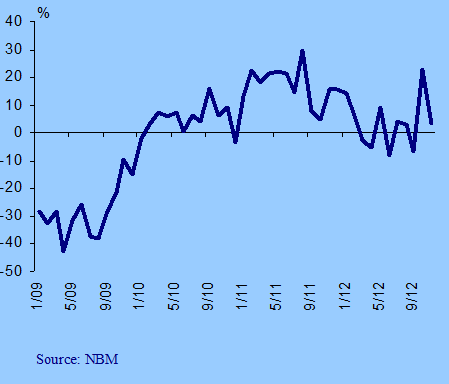
According to the Eurostat, the euro area has officially entered the technical recession for the second time in the last three years, after a contraction of 0.1 percent in the third quarter of 2012, which followed a decline of 0.2 percent in the previous quarter. Deteriorating economic situation in the euro area during 2012 had a noticeable impact on the evolution of money transfers made to individuals through the banking system, which includes Moldovan migrant remittances. Thus, their annual rate fluctuated around the value of zero in the second and third quarters of 2012, after an average of 18.0 percent recorded in 2011 (Chart no.1).
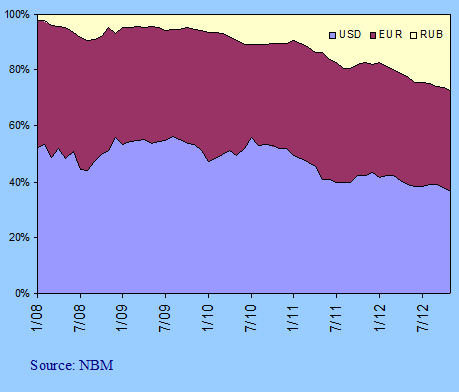
At the same time, there is a downward trend in the share of transfers in EUR and, to some extent, in USD in favor of those in RUB. Thus, if at the end of 2010, the transfers in EUR constituted more than half (51.5 percent in December), those in USD - 38.2 percent, while those in RUB only 10.3 percent after about two years the situation has changed essentially. In this way, by November 2012, the share of transfers in RUB increased significantly, reaching the level of 27.3 percent of the total, to the detriment of the EUR, which decreased its share to 36.4 percent.
In the absence of detailed statistics on persons abroad, this phenomenon suggests a reorientation of Moldovan migrants to the labor market of the Russian Federation, given that its economy grew an average by 3.9 percent in early 2012.