Welcome to the official website of the National Bank of Moldova!
×
Do you have good eyesight and want to turn this tool off?



Welcome to the official website of the National Bank of Moldova!
You can choose one of the most popular reports from the list:

National Bank and the members of its decision-making bodies shall be independent in exercising the tasks conferred upon them by law, and shall neither seek nor take instructions from public authorities or from any other authority.
In order to ensure and maintain price stability over the medium term, the National Bank’s aim will be to keep inflation (measured by Consumer Price Index) at the level of 5.0 percent annually with a possible deviation of ± 1.5 percentage points, considered to be optimal for growth and development of Moldova's economy over the medium-term.

Financial stability is achieved by strengthening the resilience of the financial system, limiting the contagion effect and reducing the accumulation of systemic risks, thus contributing to the sustainability of the financial sector and economic growth.
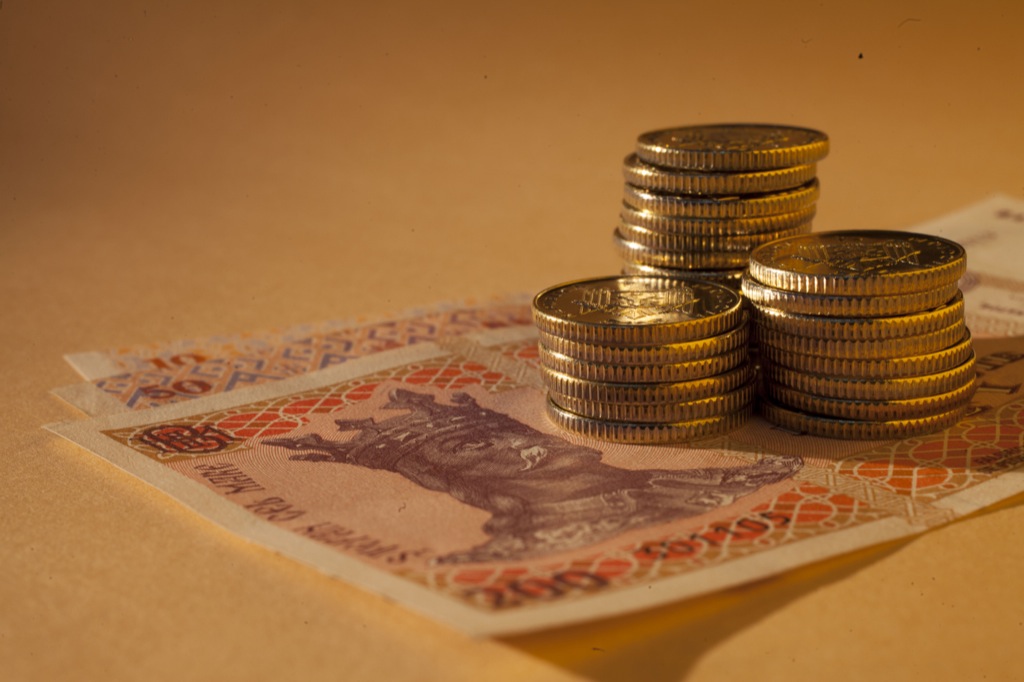
National Bank shall have the exclusive right to issue on the territory of the Republic of Moldova banknotes and coins as legal tender, as well as commemorative and jubilee banknotes and coins as legal tender and for numismatic purposes.

National Bank is exclusively responsible for the licencing, supervision and regulation of financial institutions activity.
National Bank of Moldova acts as banker and fiscal agent of the State and shall receive from state bodies economic and financial information and documents, which are necessary for carrying out its tasks.

National Bank of Moldova is an autonomous public legal entity and is responsible to the Parliament.

National Bank shall inform the public on the monetary policy strategy on the results of the macroeconomic analysis, the evolution of the financial market and on statistics, including with regard to monetary supply, crediting, balance of payments and the state of the foreign exchange market.
National Bank of Moldova is responsable for the compilation of the balance of payments, international investment position and the statistics of the external debt of the Republic of Moldova.
Inflation Report no.3, August 2012
The trend of long-term economic growth is measured by real gross domestic product growth. These increases are not constant. Over the business cycle there are periods of expansion, when economic growth remains high, followed by periods of stagnation in which economic growth is slow or even GDP decreases occur. These fluctuations are the economic cycle, duration and size of which varies both from country to country and from one period to another in the same country, which creates problems in their measurement.
GDP fluctuations are the result of shocks on aggregate demand or on aggregate supply. The demand shocks affect the total consumption income, these types of shocks can be generated for example, by fiscal policy measures (changes in taxes, fees), by changing conditions that affect saving and borrowing (interest rate changes) and balance of trade fluctuations (exports and imports). The shocks on the supply of goods and services are usually caused by labor productivity, wages, and the costs of raw materials incurred by producers.
The competition between the labor market producers, the decrease of labor productivity in the context of growing workload determines the production costs to rise. This situation creates inflationary pressures. The manufacturers may decide, for some reason, to delay the price increases. To the extent that this happens, GDP grows without the materialization of the created inflationary pressures. Once the maintenance of unchanged prices threatens to significantly reduce the profits, the producers will raise prices. In this way, the previously accumulated pressures lead, after a while, to higher prices. If other conditions in the economy remain unchanged, the increases of prices result in the reduction of consumers’ purchasing power and consequently lower demand for goods and services. As the sales can not exceed the purchases, the process ends by adjusting the production volume, the amount of labor employed in production, to an equilibrium level at which there are no inflationary pressures.
This level of GDP, at which the capital stock and actual workload engaged in manufacturing is at a level that does not generate inflationary pressures, is called potential GDP. Since potential GDP increases over time due to technological progress and the accumulation of physical and human capital, its chronological values series is called GDP trend.
Short-term real GDP can be greater than potential GDP, implying temporary accumulation of inflationary pressures. Since these pressures are even higher as production increases without changes in prices, the deviation of output from potential GDP, called output gap, is used as a synthetic measure of the intensity of pressures on prices gained in the economy. A positive output gap is determined by the level of real GDP greater than the potential GDP and indicates inflationary pressures. Symmetrically, a negative output gap indicates deflationary pressures, in terms of downward prices. In long-term, the accumulated pressures are released, prices become flexible and the output gap always tends to zero, bringing the GDP to a potential level.
The inflationary pressures are determined by the level of real GDP over the potential GDP, and real GDP is equal to the amount of goods and services required by customers, a positive output gap is also called excess demand. The excess demand can be reduced or eliminated by macroeconomic policies - monetary, fiscal and income. The monetary policy can act on excess demand through a variety of instruments; a classical measure is determined by the increase of interest rates. It aims to create incentives to increase savings so that, on one hand, the reduction of the income designated for consumption in the current period and, on the other hand, the increase of the interest rates leads to the raise of the borrowing cost, thus reducing the consumption financed by credits. The slowdown in consumption in the current period decreases the demand pressures on production, thus reducing the output gap.
Estimating the output gap is a difficult task because potential GDP is an unobservable variable. Thus, knowing the actual level of real GDP, it is not possible to directly determine what proportion of this is the potential GDP, and respectively, which is the output gap. The output gap is estimated indirectly, using both statistical techniques and expert advice. The uncertainty of estimation of potential GDP and the output gap is also emphasised by the revision of statistics on actual GDP.
Following the NBM estimates, the growth rate of potential GDP in the Republic of Moldova is 5.0 percent and is compatible with the primary objective of maintaining price stability.


