Welcome to the official website of the National Bank of Moldova!
×
Do you have good eyesight and want to turn this tool off?



Welcome to the official website of the National Bank of Moldova!
You can choose one of the most popular reports from the list:

National Bank and the members of its decision-making bodies shall be independent in exercising the tasks conferred upon them by law, and shall neither seek nor take instructions from public authorities or from any other authority.

In order to ensure and maintain price stability over the medium term, the National Bank’s aim will be to keep inflation (measured by Consumer Price Index) at the level of 5.0 percent annually with a possible deviation of ± 1.5 percentage points, considered to be optimal for growth and development of Moldova's economy over the medium-term.

Financial stability is achieved by strengthening the resilience of the financial system, limiting the contagion effect and reducing the accumulation of systemic risks, thus contributing to the sustainability of the financial sector and economic growth.

National Bank shall have the exclusive right to issue on the territory of the Republic of Moldova banknotes and coins as legal tender, as well as commemorative and jubilee banknotes and coins as legal tender and for numismatic purposes.

National Bank is exclusively responsible for the licencing, supervision and regulation of financial institutions activity.

National Bank of Moldova acts as banker and fiscal agent of the State and shall receive from state bodies economic and financial information and documents, which are necessary for carrying out its tasks.

National Bank of Moldova is an autonomous public legal entity and is responsible to the Parliament.

National Bank shall inform the public on the monetary policy strategy on the results of the macroeconomic analysis, the evolution of the financial market and on statistics, including with regard to monetary supply, crediting, balance of payments and the state of the foreign exchange market.

National Bank of Moldova is responsable for the compilation of the balance of payments, international investment position and the statistics of the external debt of the Republic of Moldova.
Inflation Report no.2, May 2012
According to Article 4 of the Law on the National Bank of Moldova of 2006, the NBM’s fundamental objective is to achieve and maintain price stability. The evolution of prices of goods and services is reflected by several statistical indicators such as CPI, industrial production price index, GDP deflator, etc.
Consumer price index (CPI) - is an evaluation indicator, which characterizes and provides an estimate of the overall development of prices for purchased goods and tariffs for services used by people to meet the needs of living in a certain period to a fixed period.
At the end of 2009, to facilitate the achievement of the fundamental objective of the National Bank of Moldova to ensure and maintain price stability, but also to learn more about the inflationary processes in the national economy, together with the NBS, the NBM developed and approved the Methodology for calculating the core inflation index. This methodology will contribute to the perception and pursuit of the NBM monetary policy actions by the general public in the context of transition to a new central bank monetary policy regime.
Core inflation index is the measurement reflecting persistent sources of inflationary pressures, which allows perceiving the inflation trend in case the effects of temporary and transitory influences are eliminated. The calculation of this index, according to this methodology, is performed by removing from the overall inflation the effects of some transient shocks such as the modifications from price and tariff changes of goods and services with regulated prices, adverse weather conditions affecting food supply, changes of price of some products and seasonal variations in international prices for fuels.
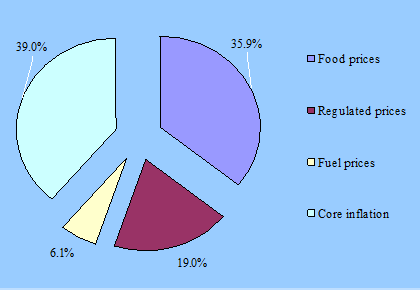
As a result, Consumer Price Index is divided into four general components, whose development allows identifying more clearly the origin of shocks affecting the inflation: core inflation, food prices, regulated prices and fuel prices. The weight of these components in 2011 is reflected in the Chart no.1.
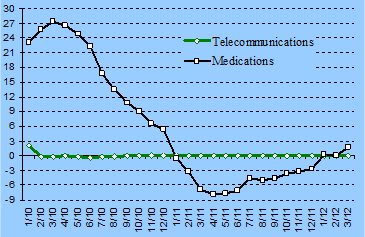
However, prices of some components (telecommunications, medications) with significant shares (5.1% and 4.8%, respectively), originally assigned to core inflation, showed a trend which didn’t vary depending on the ratio between supply and demand (Chart no.3), but were subject to regulation by the central authorities. Therefore, the prices of these subcomponents usually do not depend on aggregate demand and cannot be influenced by monetary policy actions.
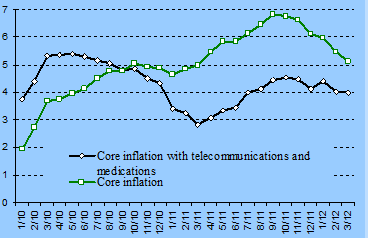
Mai mult, stabilitatea îndelungată a preţurilor la telecomunicaţii, dar şi diminuarea preţurilor la medicamente din anul precedent au avut un impact semnificativ de diminuare a inflaţiei de bază fapt ce este reflectat în graficul nr. 4 şi, în acest fel, acestea au distorsionat, într-o anumită măsură, mărimea presiunilor inflaţioniste existente în economie datorită excesului de cerere.
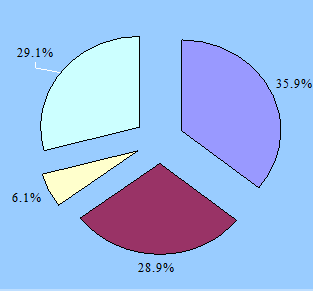
În acest sens, pentru a avea un indicator ce ar corespunde realităţii şi în baza cărora ar putea fi formulate concluzii şi recomandări obiective cu privire la măsurile de politică monetară, care ar fi necesare şi suficiente pentru a orienta cererea agregată către nivelul său de echilibru, a fost necesar de a efectua modificări în metodologia de calcul a inflaţiei de bază din anul 2009 prin includerea preţurilor la serviciile de telecomunicaţii şi medicamente în componentul servicii reglementate. În rezultatul schimbărilor efectuate în luna ianuarie 2012, ponderea preţurilor reglementate s-a majorat cu cca. 10 p.p. din contul sub-componentului inflaţia de bază, în timp ce cea a preţurilor alimentare şi a preţurilor la combustibil a rămas aceeaşi (graficul nr. 2). În acest fel, traiectoriile inflaţiei de bază şi a preţurilor reglementate din ediţia curentă a Raportului Inflaţiei reflectă schimbările sus-menţionate şi sânt diferite de cele din ediţiile anterioare ale Raportului Inflaţiei pentru perioada de până la finele anului 2011.


