Welcome to the official website of the National Bank of Moldova!
×
Do you have good eyesight and want to turn this tool off?



Welcome to the official website of the National Bank of Moldova!
You can choose one of the most popular reports from the list:

National Bank and the members of its decision-making bodies shall be independent in exercising the tasks conferred upon them by law, and shall neither seek nor take instructions from public authorities or from any other authority.

In order to ensure and maintain price stability over the medium term, the National Bank’s aim will be to keep inflation (measured by Consumer Price Index) at the level of 5.0 percent annually with a possible deviation of ± 1.5 percentage points, considered to be optimal for growth and development of Moldova's economy over the medium-term.

Financial stability is achieved by strengthening the resilience of the financial system, limiting the contagion effect and reducing the accumulation of systemic risks, thus contributing to the sustainability of the financial sector and economic growth.
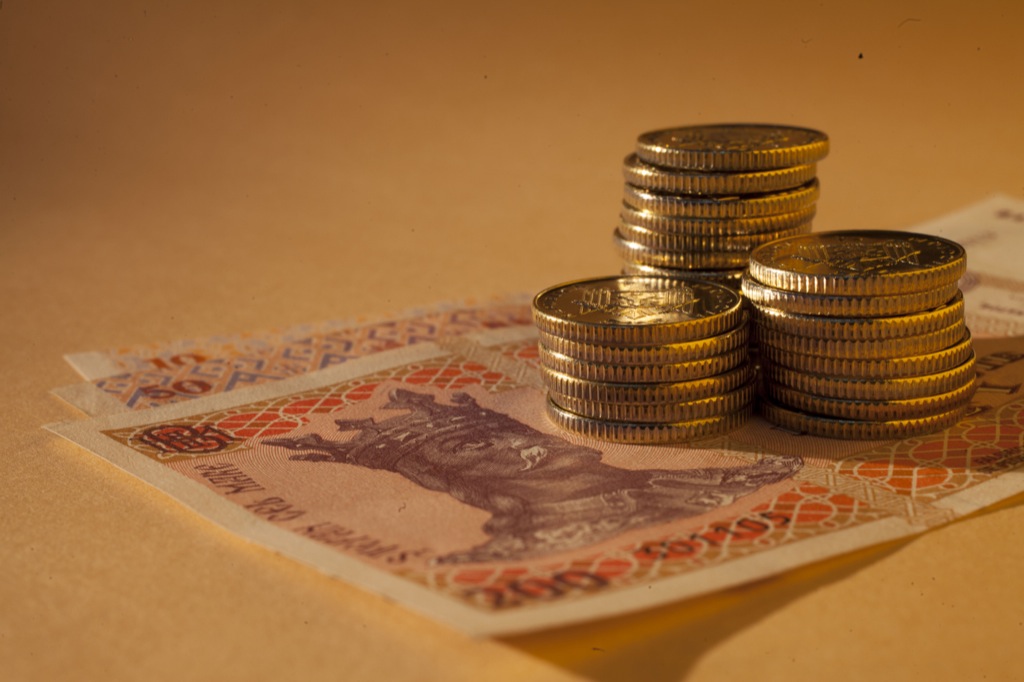
National Bank shall have the exclusive right to issue on the territory of the Republic of Moldova banknotes and coins as legal tender, as well as commemorative and jubilee banknotes and coins as legal tender and for numismatic purposes.

National Bank is exclusively responsible for the licencing, supervision and regulation of financial institutions activity.

National Bank of Moldova acts as banker and fiscal agent of the State and shall receive from state bodies economic and financial information and documents, which are necessary for carrying out its tasks.

National Bank of Moldova is an autonomous public legal entity and is responsible to the Parliament.

National Bank shall inform the public on the monetary policy strategy on the results of the macroeconomic analysis, the evolution of the financial market and on statistics, including with regard to monetary supply, crediting, balance of payments and the state of the foreign exchange market.

National Bank of Moldova is responsable for the compilation of the balance of payments, international investment position and the statistics of the external debt of the Republic of Moldova.
Inflation Report no.3, August 2012
Oil is one of the main indicators of multiple processes in the global economy. In the Republic of Moldova, there are no significant oil resources and there does not operate any refinery. Therefore, the national economy depends on imported oil derivatives and the fluctuations in international oil prices essentially affect the national economic activity rate.
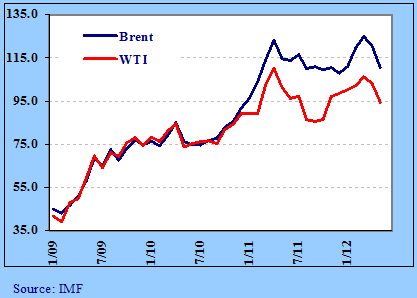
The oil extracted worldwide is not uniform in quality and, consequently, in price. Prices depend on the density, fractions, etc. The standard used for pricing is the Brent Crude oil type (hereinafter Brent), similar by composition with that extracted from the North Sea, and the supply contracts, which are concluded at London Stock Exchange. For a long time, Brent's price was by an average of USD 1 per barrel below the WTI (West Texas Intermediate or Texas light sweet) and by USD 1 per barrel above the price of the so-called “OPEC reference basket”. However, in the recent years, this situation changed and the Brent is traded at a premium to WTI, the situation being mainly generated by the disruption of oil supplies from many regions to Europe (Chart no.1).
The oil companies from the Republic of Moldova import oil derivatives mainly from Romania (gasoline - 67.3 percent, Diesel fuel - 44.5 percent), Ukraine (Diesel fuel - 32.5 percent) and Belarus (gasoline - 8.3 percent, Diesel fuel - 16.5 percent), according to the ANRE data from the “Report on the oil market in 2011”. In these countries, the refineries process mainly Urals brand oil (hereinafter Urals) – oil with a large amount of sulfur (sulfur content of about 1.3 percent), which is a mixture of oil extracted in the Khanty-Mansiisk Autonomous Area and Tatarstan. The basic producers of Urals are companies from the Russian Federation - Rosneft, Lukoil, Surgutneftegaz, Gazprom Neft, TNK-BP and Tatneft – that’s why this oil is called the Russian oil (according to www.topoilnews.com).
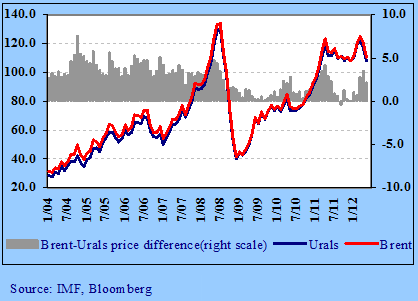
In the context of the above, in the research related to the development of Moldova's economy is preferable to operate with the Urals brand oil prices. These are determined by reference to the Brent price. Urals oil is considered to be of poor quality compared to Brent and usually Urals is sold at a discount of USD 2-3 per barrel against Brent, but there were times when the difference between these two brands was up to USD 7 per barrel (Chart no.2). During July 2011 - February 2012, the average difference between Brent and Urals was less than USD 1 per barrel. The determinant factor of reduced difference between these two brands was the introduction of the oil embargo on Iranian oil imports by the European Union, which favored the Urals brand oil prices, given the similarity of its chemical composition with the oil produced in Iran. Also, this embargo has caused an imbalance between oil supply and demand in some regions and has enabled expansion of markets for Urals brand oil, especially in the EU countries.
Even so, this was a short-term situation. After new contracts for deliveries of oil have been signed, since March 2012, the situation has stabilized, the difference between these two brands getting back to the previous levels. Thus, the precedent set by placing the embargo on oil imports from Iran shows that in the future any economic or political event or even a natural occurrence could cause a short antagonistic evolution of prices for Brent and Urals brand oil.


