Bine ați venit pe pagină oficială a Băncii Naționale a Moldovei!



Bine ați venit pe pagină oficială a Băncii Naționale a Moldovei!
Cele mai populare rapoarte statistice:
Banca Naţională şi membrii organelor de conducere ale acesteia sunt independenţi în exercitarea atribuţiilor stabilite de lege şi nu pot solicita şi nici accepta instrucţiuni de la autorităţile publice sau de la orice altă autoritate.


Banca Naţională informează publicul despre evoluția inflației anuale, strategia de politică monetară,rezultatele analizei macroeconomice, evoluţiei pieţei financiare şi informaţia statistică, inclusiv privind masa monetară, acordarea creditelor, balanţa de plăţi şi situaţia pieţei valutare.

Pentru asigurarea şi menţinerea stabilităţii preţurilor pe termen mediu, Banca Naţională a Moldovei menţine inflaţia (măsurată prin indicele preţurilor de consum) la nivelul de 5.0 la sută anual cu o posibilă abatere de ± 1.5 puncte procentuale, fiind considerat nivelul optim pentru creşterea şi dezvoltarea economică a Republicii Moldova pe termen mediu.




Stabilitatea financiară se realizează prin consolidarea rezilienței sistemului financiar, limitarea efectului de contagiune și diminuarea acumulării de riscuri sistemice, contribuind, astfel, la sustenabilitatea sectorului financiar și creșterea economică.



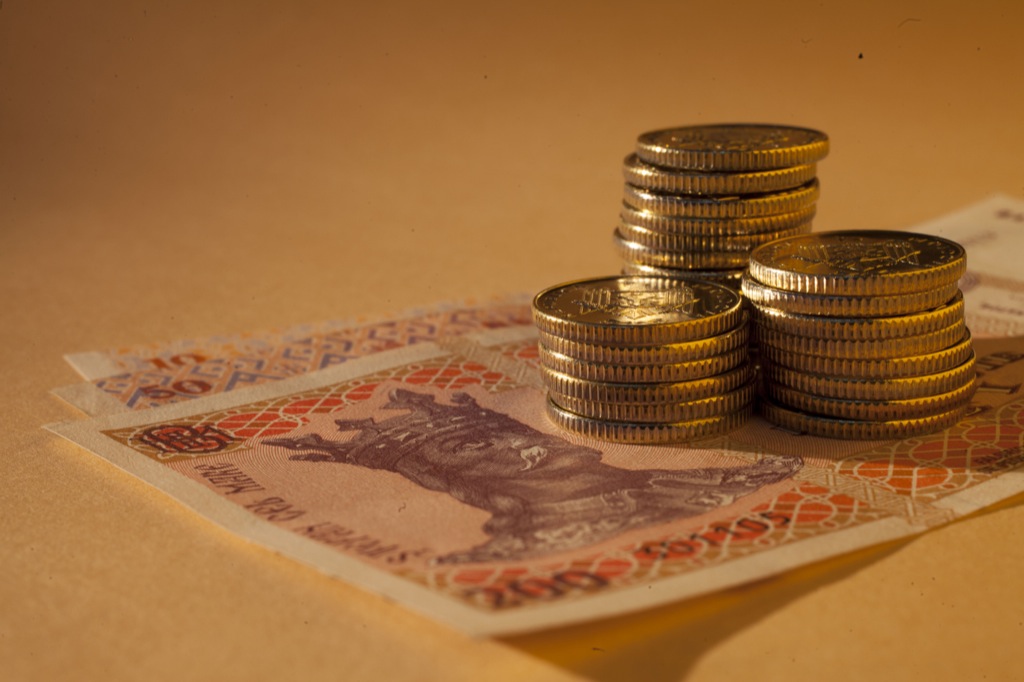
Banca Naţională a Moldovei, are dreptul exclusiv de a emite pe teritoriul Republicii Moldova bancnote şi monede metalice ca mijloc de plată. BNM pune în circulaţie bancnote şi monede metalice, prin intermediul sistemului bancar.


Banca Naţională este unica instituţie care efectuează licenţierea, supravegherea şi reglementarea activităţii instituţiilor financiare.
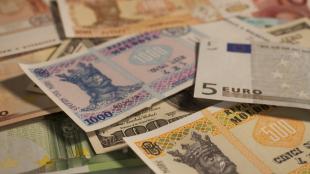

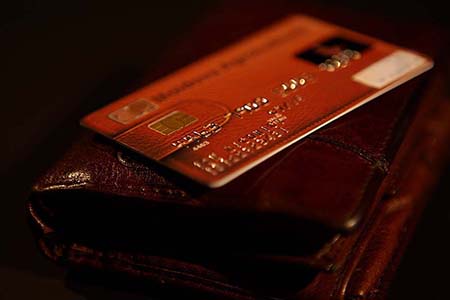
Banca Națională supraveghează sistemul de plăţi în Republica Moldova şi promovează funcţionarea stabilă şi eficientă a sistemului automatizat de plăţi interbancare.

Banca Naţională este o persoană juridică publică autonomă şi este responsabilă faţă de Parlament.

BNM publică statistici privind masa monetară, sectorul bancar, balanța de plăți, situația pieței valutare, etc. pentru a asigura transparența în procesul de elaborare și adoptare a deciziilor BNM, a asigura continuitatea în comunicare și predictibilitatea BNM pe piață, pentru sporirea credibilității BNM în calitate de bancă centrală dar și pe piața financiar-bancară din Republica Moldova.


Sursa: https://www.europeanpaymentscouncil.eu/news-insights/insight/one-year-se...
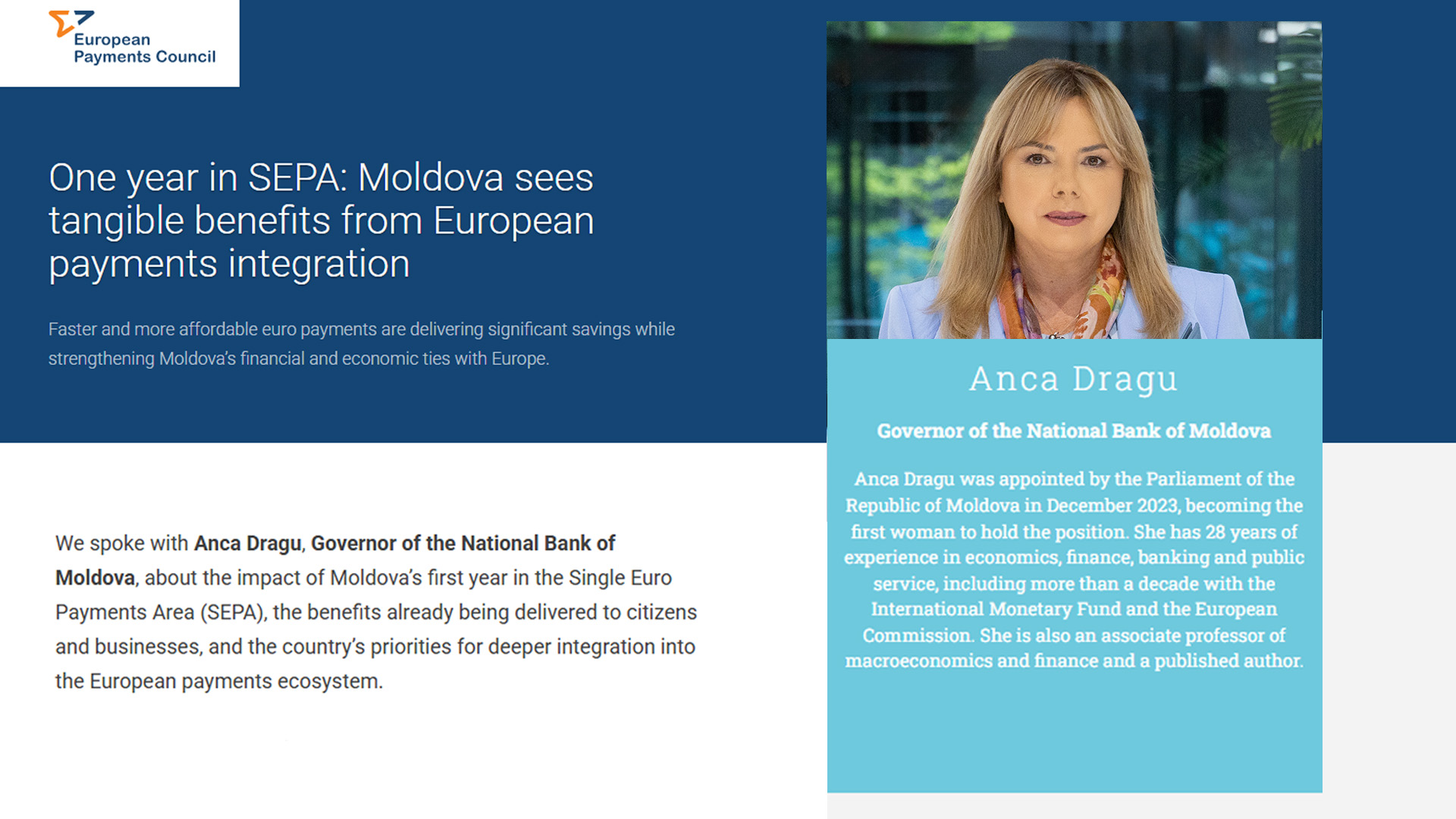
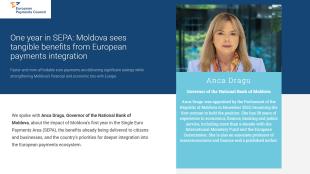
One year after joining the Single Euro Payments Area (SEPA), the Republic of Moldova is already seeing tangible benefits from its integration into the European payments ecosystem.
20 October 26
Share This
In this interview, Anca Dragu, Governor of the National Bank of Moldova (NBM), discusses the country’s first year in SEPA, the measurable benefits for citizens and businesses, and the next steps towards deeper integration into the European payments ecosystem.
The views expressed in this article are solely those of the author and should not be attributed to the European Payments Council.
The Republic of Moldova’s accession to SEPA represents a strategic achievement and a milestone in the country’s European integration process. It confirms that Moldova’s financial system is aligned with European standards of efficiency, security and transparency.
From an economic perspective, joining SEPA has strengthened Moldova’s integration into the European financial architecture. This is particularly important given that around 60% of Moldova’s foreign trade is conducted with the European Union, more than 60% of foreign direct investment originates from EU countries, and a significant share of remittances comes from Moldovan citizens living and working in the European Union.
“SEPA has demonstrated that European integration can deliver tangible benefits within a relatively short period.”
For citizens and businesses, European integration is no longer an abstract concept. It is reflected in lower payment costs, faster transfers, greater predictability and closer economic links with the European Union.
The impact has been both rapid and measurable. Since 6 October 2025, when Moldovan banks became operational participants in SEPA, euro-denominated payments between Moldova and SEPA countries have become significantly more affordable and faster.
In the first seven months of participation, Moldovan citizens and companies carried out more than 646,000 SEPA transactions, with a total value exceeding 4.8 billion euro.
The average fee paid by customers was approximately 3.5 euro per transaction, compared with estimated fees of between twenty euro and several hundred euro under the previous correspondent banking arrangements.
This generated direct savings of approximately 16.4 million euro for citizens and businesses during the first seven months alone. On an annual basis, the estimated savings could reach around 30 million euro.
Beyond the financial savings, transaction times have been considerably reduced. Most SEPA credit transfers are completed within one business day, while many are processed on the same day. This has improved cash-flow management for businesses and has made cross-border payments more accessible and predictable for individuals.
SEPA participation has created a new competitive benchmark for Moldovan banks. Customers can now compare the cost and quality of euro payments with those offered by banks across the European Union. This has encouraged banks to revise their pricing policies, improve processing times and invest further in digital infrastructure.
The integration process also required banks to modernise their payment systems, enhance straight-through processing and strengthen operational resilience. These improvements are not limited to euro payments; they also contribute to the overall digitalisation and efficiency of the banking sector.
In addition, SEPA membership has increased the attractiveness of the Moldovan market for European payment institutions and fintech companies. This creates opportunities for new partnerships, innovative services and increased competition, ultimately benefiting consumers and businesses.
The National Bank of Moldova played a central coordinating and regulatory role throughout the entire process. SEPA accession required a comprehensive alignment of the national legal, regulatory and operational framework with European standards.
The NBM coordinated the preparation of the national application, worked closely with the European Payments Council and supported commercial banks throughout the technical and operational readiness process. This included the adoption of European payment standards, the implementation of ISO 20022 messaging, the strengthening of anti-money laundering and sanctions-screening frameworks, and the improvement of operational resilience.
The transition was supported by close cooperation between the central bank, commercial banks, public authorities and international partners. This coordinated approach ensured that Moldovan banks were able to become operational SEPA participants without disruption to customers.
SEPA and MIA are complementary components of Moldova’s payment modernisation strategy.
SEPA connects Moldova to the European payments market and facilitates efficient euro-denominated transfers. MIA, launched by the National Bank of Moldova, provides instant domestic payments in Moldovan lei, available around the clock.
“This model demonstrates that European integration and the development of national payment infrastructure are not competing processes but mutually reinforcing ones.”
Together, SEPA and MIA contribute to reducing transaction costs, improving payment speed, increasing financial inclusion and reducing dependence on cash.
The experience gained through SEPA also supports the further development of Moldova’s instant payment infrastructure and its future interoperability with European payment systems.
Several important trends have emerged:
| 01 | A rapid migration of euro payments from traditional correspondent banking channels to SEPA; |
| 02 | A significant increase in the number of lower-value cross-border payments made by individuals and small businesses; |
| 03 | Growing use of digital channels for initiating cross-border transfers; |
| 04 | Increased price competition among banks; |
| 05 | Greater customer expectations regarding speed, transparency and digital accessibility. |
These developments indicate that SEPA has not only reduced costs but has also contributed to changing payment behaviour and accelerating the digitalisation of financial services.
“The next stage for the Republic of Moldova is to move from connectivity to SEPA towards deeper integration into the European payments ecosystem.”
A key priority is expanding participation in SEPA schemes and ensuring that all eligible financial institutions can benefit from the European payments infrastructure.
Another important objective is to explore participation in SEPA Instant Credit Transfer, which would enable real-time euro payments between Moldova and SEPA countries. This would further improve the speed and convenience of cross-border transactions.
The National Bank of Moldova will also continue to promote digital payments, strengthen cybersecurity and operational resilience, and support innovation in the financial sector.
Ultimately, the objective is to ensure that Moldova’s payment system becomes fully interoperable, competitive and aligned with the European financial market.


